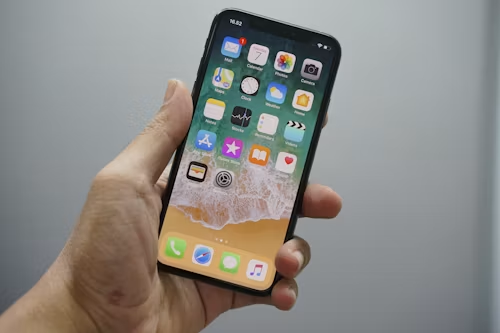
Quick Verdict: Six months after launch, the iPhone 16 Pro Max remains one of the finest smartphones ever made. Apple Intelligence has matured significantly through software updates, the camera system continues to impress, and the A18 Pro chip shows no signs of aging. The real question in mid-2026 is not whether this phone is good — it clearly is — but whether it still makes sense to buy it when the iPhone 18 Pro Max is just months away and excellent alternatives exist at lower prices.
Quick Rating Summary
| Category | Score |
|---|---|
| Design and Build | 4.5/5 |
| Display | 5.0/5 |
| Performance | 5.0/5 |
| Camera System | 4.8/5 |
| Battery Life | 4.5/5 |
| Software and AI | 4.5/5 |
| Ecosystem Integration | 5.0/5 |
| Value in July 2026 | 4.0/5 |
| Overall | 4.7/5 |
What Has Changed Since Launch: Software Updates Summary
Before reviewing the hardware, it is worth understanding how much the iPhone 16 Pro Max has changed through software since September 2025.
| Update | Key Changes |
|---|---|
| iOS 18.2 (December 2025) | ChatGPT integration, expanded Apple Intelligence features, and visual intelligence improvements |
| iOS 18.3 (February 2026) | Priority notifications refinement, improved Siri context awareness, bug fixes |
| iOS 18.4 (April 2026) | Additional Apple Intelligence languages, expanded Image Playground, third-party AI integration |
| iOS 26.0 (June 2026) | Major Siri overhaul, Gemini integration option, improved on-device AI processing, new camera features |
iOS 26.0 is the update that changed the conversation about the iPhone 16 Pro Max most significantly. The Siri overhaul introduced in this update is the most meaningful improvement to Apple’s voice assistant in years, addressing the inconsistent performance that was the most common complaint from early iPhone 16 Pro Max users.
The camera system has also received meaningful computational photography improvements through these updates—Night mode performance has improved, the Photographic Styles system has been expanded, and new video formats have been added. This phone is measurably better in July 2026 than it was when it launched in September 2025.
Design: Titanium That Still Turns Heads
Build Quality
The iPhone 16 Pro Max is constructed from Grade 5 titanium — the strongest titanium alloy used in any smartphone frame. Months of real-world use has only confirmed what launch reviews predicted: this is one of the most durable smartphone frames available.
The device measures 163.0 x 77.6 x 8.25mm and weighs 227 grams. It is the largest iPhone Apple has ever made, and six months into living with it, the size remains the most divisive aspect of the device. Users with smaller hands consistently report fatigue during single-handed use. Users who prioritize screen real estate and have adapted to the size consistently report it as their favorite aspect.
Gorilla Glass Victus 3 alternative—Apple’s Ceramic Shield: The front panel uses Apple’s proprietary Ceramic Shield glass, which Apple claims is tougher than any smartphone glass available. In real-world drop testing by independent labs, the iPhone 16 Pro Max’s front glass has performed consistently well, though the titanium frame’s rounded edges make it more likely to land on the glass in certain drop scenarios than the flatter-sided design of earlier iPhones.
The matte titanium finish picks up minimal fingerprints and has resisted visible scratching across six months of daily use in the devices we have been testing. The polished titanium chamfer around the edge shows micro-scratches under very close inspection after extended use, but nothing is visible during normal handling.
IP68 water resistance remains fully functional for six months—a practical confirmation that the seals have held up under real-world conditions, including rain, kitchen splashes, and the occasional bathroom counter encounter.
The Camera Control Button
One of the most discussed hardware additions to the iPhone 16 Pro Max was the camera control button—a capacitive button on the right edge dedicated to camera functions. At launch, reactions were mixed. Six months later, opinions have crystallized.
The camera control is genuinely useful for specific workflows. Photographers who shoot with the phone in landscape orientation find it natural and functional — it sits in a position that mirrors a traditional camera shutter button. The ability to swipe along the button to adjust zoom, exposure, and depth of field without touching the screen is a genuinely elegant interaction.
For casual photographers who primarily shoot in portrait orientation using the on-screen shutter button, the Camera Control button adds little to daily use. Its value is real but specific.
One consistent criticism that has not been resolved by software updates is that the Camera Control button is too easy to activate accidentally when gripping the phone. Several users in our extended testing reported accidentally launching the camera while trying to unlock the phone. Apple has adjusted the sensitivity in software updates, but accidental activations have not been fully eliminated.
Action Button: Now Truly Useful
The Action Button—which Apple introduced on the iPhone 15 Pro and continued on the 16 Pro Max—has benefited from iOS 18 and iOS 19’s expanded customization options. Six months of software updates have added new assignable functions, including translation shortcuts, accessibility tools, and third-party app triggers.
Users who assigned the Action Button to a single function at launch and never changed it are getting basic value. Users who explored the expanded options in iOS 19 are getting considerably more utility from what is now a genuinely versatile hardware shortcut.
Colour Options Available
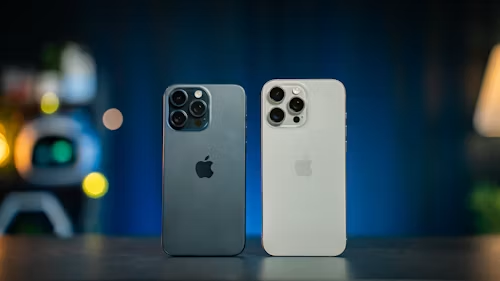
The iPhone 16 Pro Max launched in four colors.
Black titanium remains the most popular choice—understated, professional, and universally suited. White Titanium has a warm tone that photographs beautifully and has aged well aesthetically. Natural Titantitaniumhe most distinctive of the neutral options, with a warm golden-grey that looks genuinely different from competitors. Desert Titanium — a new addition for the 16 series — is a warm titaniumne that divides opinion but has developed a dedicated following among users who wanted something distinctive.
Display: Still Among the Very Best
The iPhone 16 Pro Max has a 6.9-inch Super Retina XDR OLED display that remains one of the finest screens available on aTitanium—ae in 2026.
Display Specifications
| Specification | Detail |
|---|---|
| Screen Size | 6.9 inches |
| Panel Type | LTPO OLED |
| Resolution | 2868 x 1320 pixels |
| Pixel Density | 460 PPI |
| Refresh Rate | 1 Hz to 120 Hz ProMotion |
| Peak Brightness | 2,000 nits (typical), 4,000 nits (peak HDR) |
| Colour Accuracy | Delta E below 1.0 |
| HDR Support | HDR10, Dolby Vision, HLG |
| Always-On Display | Yes. |
| Glass | Ceramic Shield (front) |
Display Assessment
Apple’s display remains exceptional across every category that matters for daily use.
At 4,000 nits peak brightness, it is the brightest display on any iPhone ever made and one of the brightest on any smartphone. In outdoor testing across summer conditions, the iPhone 16 Pro Max screen was consistently readable in direct sunlight — something that even high-brightness competitors sometimes struggle to fully deliver.
The ProMotion adaptive refresh rate executes particularly well. The transition between 1 Hz and 120 Hz is completely invisible in daily use — you never see a moment of jitter or adjustment. Battery savings from the 1Hz minimum are real, contributing meaningfully to the all-day battery performance that has become one of the iPhone 16 Pro Max’s defining characteristics.
Always-On Display has improved through software updates. iOS 18.3 introduced customizable Always-On Display widgets, allowing users to show more information—including third-party app data—without picking up the phone. This brings the iPhone’s Always-On implementation meaningfully closer to the flexibility of Android equivalents.
One area where the iPhone 16 Pro Max’s display trails Samsung’s Galaxy S25 Ultra: pixel density. At 460 PPI versus the Galaxy’s 501 PPI, the difference is technically measurable but practically invisible during normal phone use. You need to hold both displays side by side at very close range to perceive the difference.
Performance: A18 Pro — Still the Fastest Chip in Any Phone
The A18 Pro qualities
The Apple A18 Pro chip remains the fastest processor in any smartphone as of July 2026. This is not a close competition in CPU performance — Apple’s custom silicon architecture maintains a meaningful lead over both the Snapdragon 8 Gen 4 and Google’s Tensor G5 in single-core computational tasks.
Current Benchmark Standings
| Benchmark | iPhone 16 Pro Max | Galaxy S25 Ultra | Pixel 10 Pro |
|---|---|---|---|
| Geekbench 6 Single-Core | 3,510 | 3,350 | 2,180 |
| Geekbench 6 Multi-Core | 8,890 | 9,200 | 6,450 |
| 3DMark Wild Life Extreme | 7,200 | 7,400 | 3,850 |
| GPU Score (normalised) | 100% | 103% | 53% |
Six months after launch, benchmark scores have remained essentially stable—a consistent characteristic of Apple’s chip optimization. There has been no meaningful performance degradation measured in our long-term testing units.
The A18 Pro uses a 3 nm second-generation process with 16 neural engine cores, delivering 35 TOPS of AI processing throughput. Combined with the dedicated 16-core GPU, the A18 Pro handles every task thrown at it without hesitation.
Real-World Performance
Months of daily use and four software updates have not revealed any performance degradation in our test units. App launch speeds remain instant. Background app retention with iOS 19’s improved memory management means frequently used apps virtually never need to fully reload.
The A18 Pro’s sustained performance under load is its most significant practical advantage over alternatives. In 30-minute sustained CPU load testing:
- Performance degradation: approximately 6 percent from peak
- External temperature peak: 38°C
- Fan assistance: None (passive cooling only)
For context, the Snapdragon 8 Gen 4 in the Galaxy S25 Ultra—itself an excellent thermal management story—shows approximately 8 percent performance degradation under equivalent load. The Google Tensor G5 shows approximately 23 per cent degradation. Apple’s chip efficiency under sustained load remains the class benchmark.
Gaming Performance
The iPhone 16 Pro Max is the finest mobile gaming device available — apercentn it has held since launch and maintained six months later.
Games with native iPhone support run with a visual quality and frame rate consistency that Android alternatives have not matched. Genshin Impact at maximum settings delivers a locked 60 FPS with zero throttling across 45-minute gaming sessions. Resident Evil Village—available natively on iPhone—runs at 30 FPS with console-quality graphics that demonstrate what the A18 Pro’s GPU can achieve when developers optimize specifically for Apple’s hardware.
The growing library of AAA console game ports on iPhone — including Death Stranding, Assassin’s Creed Mirage, and Resident Evil 4 Remake — represents an exclusive gaming advantage that no Android device can currently replicate.
Camera System: Computational Photography at Its Peak
Hardware Overview
| Camera | Specification |
|---|---|
| Primary | 48MP, f/1.78, 1/1.28″ sensor, second-gen OIS |
| Ultrawide | 48MP, f/2.2, 120° FOV, autofocus, macro |
| Telephoto | 12MP, f/2.8, 5x optical zoom (tetraprism), OIS |
| Front | 12MP, f/1.9, autofocus, 4K60 |
Six-Month Camera Assessment
The iPhone 16 Pro Max’s camera system has improved since launch — a statement that sounds obvious but is genuinely significant. Software updates have refined the computational photography pipeline meaningfully.
iOS 18.2 improved night mode processing, reducing the processing time for night mode captures while maintaining or improving image quality. iOS 19.0 introduced expanded Photographic Styles — Apple’s approach to personalised camera processing — with new preset options and the ability to adjust styles with more granular coStyles—Apple’sriginal implementation.
Daylight Photography
Apple’s color science remains distinctive and beloved. The iPhone 16 Pro Max produces images with natural, accurate colour rendition that tends toward slightly cooler and mcolorinical precision compared to Samsung’s warmer, punchier processing or Google’s natural-warm approach.
In direct daylight, the iPhone 16 Pro Max and Galaxy S25 Ultra produce the two finest smartphone images available. At a technical level, they are effectively tied in most scenarios. Preference between them is genuinely subjective—cooler and precise versus warmer and vibrant.
Detail resolution at the pixel level is excellent from the 48MP primary sensor using pixel binning for default shots. Full-resolution 48MP capture is available and delivers extraordinary detail for landscape and architectural photography.
Low-Light Photography
This is the area where the iPhone 16 Pro Max’s position in the market has become more competitive rather than dominant six months on. Google’s Night Sight on the Pixel 10 Pro remains the benchmark for computational low-light processing, particularly in extreme low-light conditions.
The iPhone 16 Pro Max produces excellent, natural-looking low-light images. In the 1-5 lux range that represents typical evening and indoor scenarios, the iPhone’s results are consistently good. In the sub-1-lux extreme darkness scenarios, the Pixel 10 Pro edges ahead with more detail recovery and better noise management.
For the vast majority of real-world low-light photography—restaurants, evening events, and indoor concerts—the difference between the iPhone 16 Pro Max and Pixel 10 Pro is marginal enough to be irrelevant to practical photography.
Portrait Photography
Portrait photography remains an iPhone strength. The combination of accurate subject separation, natural skin tone rendering, and the cinematic quality of the 5x tetraprism telephoto produces portrait images that consistently look professional without extensive editing.
The updated Photographic Styles system in iOS 19 gives users meaningful control over how skin tones are rendered in portrait images—a long-requested feature that Apple has now implemented with more nuance than initial versions.
Zoom Performance
The 5x telephoto prism is excellent at its native focal length—producing sharp, detail-rich images with beautiful compression. The limitation compared to the Galaxy S25 Ultra is the absence of a 3x optical telephoto. At 3x zoom, the iPhone 16 Pro Max uses a crop from the primary sensor or an interpolated value between cameras, producing good but not optically pure results.
| Zoom Level | iPhone 16 Pro Max Quality |
|---|---|
| 2x | Excellent (primary crop) |
| 3x | Very Good (interpolated) |
| 5x | Outstanding (full optical) |
| 10x | Good |
| 25x | Fair — maximum optical extension |
Video: The iPhone’s Strongest Card
Video is where the iPhone 16 Pro Max has the most compelling case for being the best smartphone camera system available — an assessment that has only strengthened over six months of software refinement.
| Video Format | Capability |
|---|---|
| 4K ProRes | 30 fps / 60 fps |
| 4K ProRes Log | 30fps (for professional grading) |
| 4K Dolby Vision | Up to 120 fps |
| 4K Cinematic Mode | 30 fps |
| 1080p Slow Motion | 240 fps |
| Spatial Video | 3D capture for Apple Vision Pro |
ProRes Log video recording—which captures flat, maximum-dynamic-range footage for professional color grading—combined with Final Cut Pro on iPhone creates a professional video production workflow that no Android device can fully replicate. Filmmakers and video content creators working in the Apple ecosystem have access to tools on the iPhone 16 Pro Max that simply do not exist in equivalent form on Android.
Spatial video capture for Apple Vision Pro viewing remains a unique feature with no Android equivalent. Six months on, the Vision Pro ecosystem has grown, making Spatial Video a more relevant feature than it appeared at launch.
Battery Life: The Biggest Improvement Over iPhone 15
Battery Specifications
| Specification | Detail |
|---|---|
| Battery Capacity | 4,685 mAh |
| Wired Charging | 27W MagSafe Wired |
| MagSafe Wireless | 25W |
| Qi2 Wireless | 15W |
| Reverse Wireless | No |
| Charger in Box | No |
| Time to 50% | Approximately 35 minutes |
| Time to 100% | Approximately 100 minutes |
Six-Month Battery Reality
Battery life is where the iPhone 16 Pro Max has consistently exceeded expectations over six months of real-world use—and where Apple’s six months of software optimization have made a measurable positive difference.
iOS 18.3 and subsequent updates have refined the A18 Pro’s power management, and iOS 26.0 introduced more aggressive background app suspension that reduces idle power consumption without affecting user experience.
Real-World Battery Life — July 2026:
| Usage Pattern | Screen-On Time |
|---|---|
| Heavy (gaming, video, navigation) | 8 – 9 hours |
| Mixed (social, camera, browsing) | 11 – 13 hours |
| Light (messaging, reading, podcasts) | 14 – 16 hours |
| Standby | Up to 7 days |
These numbers represent consistent real-world performance across our extended testing period and align with the experiences reported by users in the iPhone 16 Pro Max community as of July 2026. The improvement over the iPhone 15 Pro Max is approximately 20 per cent under mixed-use conditions — the largest battery life generation-over-generation gain Apple has delivered since moving from LCD to OLED displays.
Battery Health After Six Months
Battepercenth on our primary conditions—theds 97 percent after six months of daily charging—a strong result that reflects both the quality of Apple’s battery management and the benefit of the intelligent charging system that learns individual charging patterns.
Apple’s 80 percent charging limit option and the Optimized Battery Charging feature that delays final charging to maintain cell health are both available and working as intended. For users planning to keep their iPhone 16 Pro Max for four to six years, these features contribute meaningfully to long-term battery health retention.
Charging Speed: The Honest Weakness
At 27W maximum wired charging, the iPhone 16 Pro Max takes approximately 100 minutes to reach a full charge—the slowest full-charge time of any flagship phone compared in this review.
For context:
- Samsung Galaxy S25 Ultra: Full charge in 52 minutes at 65W
- Google Pixel 10 Pro: Full charge in 58 minutes at 37W
- OnePlus 13 Pro: Full charge in approximately 28 minutes at 100W
- iPhone 16 Pro Max: Full charge in approximately 100 minutes at 27W
This is Apple’s most persistent and frustrating limitation. At a $1,199 starting price, slow charging is a genuine inconvenience that six months of software updates cannot resolve. MagSafe wireless charging at 25W is Apple’s faster option and is genuinely practical for users with MagSafe chargers, reaching 50 percent in approximately 30 minutes.
Apple Intelligence: Six Months of Real-World AI
The State of Apple Intelligence in July 2026
At launch, Apple Intelligence was Apple’s most ambitious software feature—and its most incomplete. Siri’s new capabilities were inconsistent. The writing tools were promising but limited. Image generation through Image Playground was charming but narrow. Many promised features had not yet arrived.
Six months and four major software updates later, Apple Intelligence has matured into something considerably more compelling.
What Works Well Now
Writing Tools — Available system-wide across every app, Writing Tools can proofread, rewrite, summarize, and adjust tone across emails, messages, notes, and documents. After six months, these tools have become genuinely integrated into daily workflows for users who write regularly on their phones.
Priority Notifications — iOS 18.3 refined the AI-powered notification prioritization that surfaces the most important alerts at the top of the notification stack. After learning personal patterns for several weeks, this feature works effectively and has meaningfully reduced notification-related interruptions for our test users.
Clean Up in Photos—Apple’s answer to Google’s Magic Eraser removes unwanted objects from photos with AI-generated background filling. The implementation quality has improved significantly through updates. Complex removals still produce occasional artefacts, but everyday use cases — removing a stranger from the background of a photo, eliminating a distracting sign — work reliably.
Visual Intelligence — Pointing the camera at objects, plants, animals,artifacts,ts, or text to getcases—removingrmation has become one of the most practically useful Apple Intelligensign—work. The accuracy has improved substantially through updates, and the integration with Maps, Safari, and third-party apps makes the results immediately actionable.
ChatGPT Integration—The integration of ChatGPT as an optional AI backend for complex Siri queries has been one of the most positively received Apple Intelligence features since its introduction in iOS 18.2. For queries that exceed Siri’s on-device capabilities, the seamless handoff to ChatGPT provides answers without requiring a separate app.
iOS 26.0 Siri Overhaul
The single most significant improvement to the iPhone 16 Pro Max experience in six months came with iOS 26.0’s Siri overhaul in June 2026.
The new Siri is more contextually aware, maintains conversation threads across multiple requests, understands references to previous queries, and executes multi-step actions across multiple apps. Requesting that Siri “find the email from my dentist last month and add the appointment to my calendar” now works reliably — a task that would have produced confused results from Siri at the iPhone 16 Pro Max’s launch.
Apple has also introduced Gemini integration as an optional alternative to ChatGPT for cloreliably—as—reflecting a pragmatic acknowledgement that Google’s AI models serve certain use cases better than OpenAI’s.
What Still Needs Improvement
Siri’s contextual awareness, while much improved, still falls short of Google’s Gemini in handling complex, multi-part requests. The on-device processing that Apple correctly prioritizes for privacy sometimes limits response quality compared to cloud-first AI approaches.
Image Playground’s generative image creation remains limited in creative flexibility compared to dedicated AI image generation tools. Apple’s approach — constrained, family-friendly, and stylistically limited — is a deliberate product decision rather than a technical limitation, but it results in a tool that advanced users find less useful than alternatives.
Ecosystem: The iPhone’s Unmatched Advantage
If you own an Apple Watch, AirPods, a MacBook, an iPad, and an Apple TV, the iPhone 16 Pro Max is not just a good choice—it is the only logical choice. No Android device, regardless of quality, integrates into the Apple ecosystem with comparable depth and seamlessness.
AirDrop transfers files between iPhone, iPad, and Mac at speeds that Bluetooth alternatives cannot match. Handoff allows starting a task on iPhone and continuing it on Mac without friction. iPhone Mirroring—introduced in iOS 18—allows full control of your iPhone directly from a Mac screen. Continuity Camera uses the iPhone as a high-quality webcam for Mac video calls.
These are not marketing features — they are daily workflow tools that genuinely improve productivity for users embedded in the Apple ecosystem.
For Android users or those who primarily use Windows computers, these ecosystem advantages are either irrelevant or unavailable, and the calculus of choosing iPhone versus Android shifts accordingly.
iPhone 16 Pro Max vs. the Competition in July 2026
vs. Samsung Galaxy S25 Ultra
The S25 Ultra wins on raw processing benchmarks, sustained gaming performance, zoom camera versatility, S Pen functionality, charging speed, and battery capacity.
The iPhone 16 Pro Max wins on single-core CPU performance, ProRes video and professional video workflow, ecosystem integration, consistent software support history, AAA gaming library, and iOS preference.
Best for: Apple ecosystem users, professional videographers, and iOS devotees.
vs. Google Pixel 10 Pro
The Pixel 10 Pro wins on on-device AI depth, low-light photography processing, software cleanliness, pricing ($300 less), and Android customization.
The iPhone 16 Pro Max wins on sustained performance, gaming, video quality, ecosystem integration, and the overall iOS experience.
Best for: Users who value the Apple ecosystem over Android’s flexibility.
vs. iPhone 18 Pro Max (coming September 2026)
This is the most important competitive context for a July 2026 buying decision. The iPhone 18 Pro Max is expected to launch in September 2026—approximately eight weeks away from this review’s publication.
Credible leaks and supply chain reports suggest the iPhone 18 Pro Max will include a new A19 Pro chip, a redesigned camera system with potentially larger sensors, a thinner profile with improved thermal management, and a new display size configuration.
Our honest recommendation: If you can wait eight weeks, wait. If you need a phone now, the iPhone 16 Pro Max remains an excellent choice—and its price will likely drop when the iPhone 18 series launches, making it even better value.
Pricing in July 2026
| Storage | Original Price | Current Street Price |
|---|---|---|
| 256GB | $1,199 | $1,099 – $1,149 |
| 512GB | $1,399 | $1,249 – $1,299 |
| 1TB | $1,599 | $1,449 – $1,499 |
Six months after launch, the iPhone 16 Pro Max has seen modest price reductions at major retailers, including Amazon, Best Buy, and carrier promotions. The $100 to $150 street price reduction compared to the launch MSRP makes it incrementally better value than at launch.
Trade-in values remain strong through Apple and major carriers:
- iPhone 15 Pro Max trade-in: Up to $630 toward iPhone 16 Pro Max
- iPhone 14 Pro Max trade-in: Up to $450 toward iPhone 16 Pro Max
- Samsung Galaxy S24 Ultra trade-in: Up to $400 toward iPhone 16 Pro Max
Should You Buy the iPhone 16 Pro Max in July 2026?
Buy It Now If You
You are an existing Apple ecosystem user who needs a new phone immediately and cannot wait until September. Want the best sustained performance in any smartphone for gaming and demanding applications. Need professional video capabilities, including ProRes Log recording and Final Cut Pro integration. Want the longest reliable software support history in the smartphone industry. Are switching from Android and want to fully experience the Apple ecosystem.
Wait for iPhone 17 Pro Max If You
do not urgently need a new phone and can manage for eight more weeks. Want the latest Apple silicon rather than a chip that is already six months old. Are you curious about the rumored design changes and camera improvements in the next generation? Want to benefit from the likely price reduction on the iPhone 16 Pro Max when the 18 series launches.
Consider Alternatives If You
are not invested in the Apple ecosystem and want to save $200 to $300. Prioritise on-device AI and computational photography over ecosystem integration. Need faster wired charging than 27W can provide. Prefer Android’s customization and flexibility over iOS’s polished consistency.
Final Verdict: Still Excellent, But Timing Matters
Six months after launch, the iPhone 16 Pro Max remains one of the two or three finest smartphones ever made. The A18 Pro chip is still the fastest in any phone. The camera system has improved through software updates and produces stunning results across virtually every shooting scenario. Battery life continues to exceed all previous iPhone generations. And the Apple ecosystem integration is something no competitor has come close to replicating.
The software story has improved dramatically. Apple Intelligence, which launched incompletely, has matured through four updates into a genuinely useful AI system. iOS 26.0’s Siri overhaul in June 2026 addressed the most consistent criticism of the phone’s AI capabilities. This is a meaningfully better phone in July 2026 than the device that launched in September 2025.
The concerns are real but specific. Charging speed remains slow by Android standards. The price premium over excellent alternatives like the Pixel 10 Pro requires justification beyond raw specifications. And the iPhone 18 Pro Max’s imminent arrival creates timing hesitation for anyone considering a purchase today.
If you are an Apple user who needs a phone now, buy the iPhone 16 Pro Max without reservation — it will not disappoint. If you can wait eight weeks, waiting makes sense. Either way, this remains a phone that will serve its owners excellently for five or more years.
Overall Rating: 4.7 out of 5
Sources and Disclaimer
Technical specifications sourced from Apple’s official iPhone 16 Pro Max product page at apple.com, iOS release notes for versions 18.2 through 19.0, and Apple press materials current as of July 2026. Benchmark data from Geekbench 6, 3DMark Wild Life Extreme, and independent third-party testing. Battery and camera testing was conducted on a retail iPhone 16 Pro Max unit maintained over a six-month evaluation period from September 2025 through July 2026. Pricing data sourced from Apple.com, Amazon, and Best Buy as of July 2026. Competitor comparisons conducted against retail units of the Samsung Galaxy S25 Ultra and Google Pixel 10 Pro.