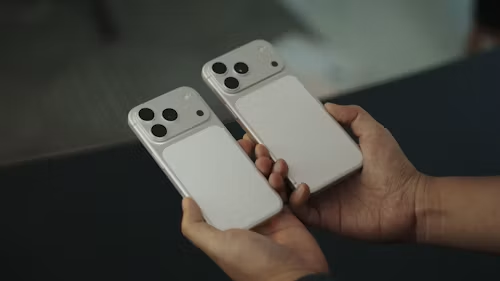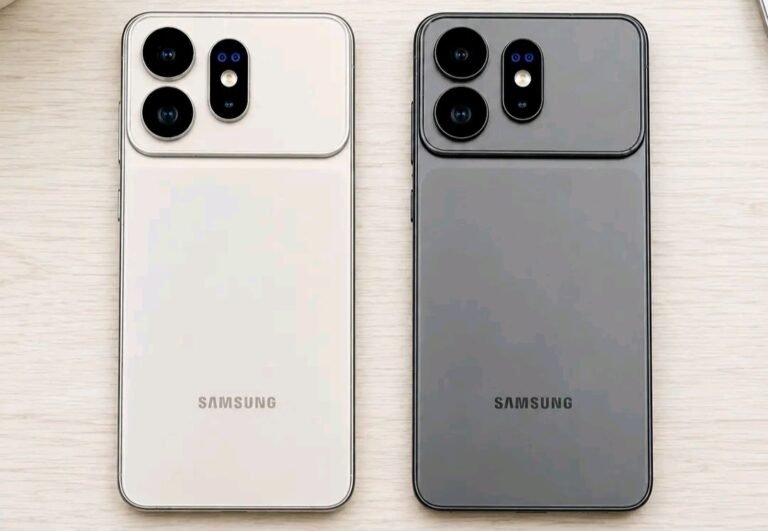
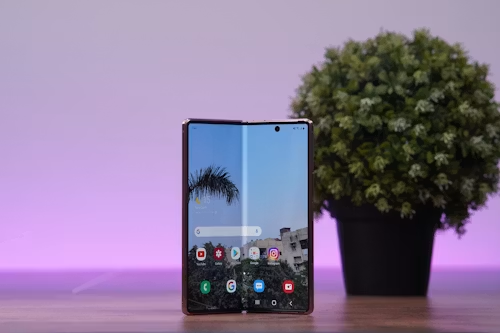
Samsung officially unveiled the Galaxy Z Fold 8 at its summer Unpacked event in London on July 22, 2026 — and it’s the most radical redesign the Fold line has seen since it launched. Rather than a routine spec bump, Samsung has split its book-style foldable lineup in two: the new, wider Galaxy Z Fold 8 reviewed here, built as a content- and media-first device, and the Galaxy Z Fold 8 Ultra, which carries the torch for the traditional, taller Fold shape. Here’s everything you need to know.
The Big Idea: A New Shape Entirely
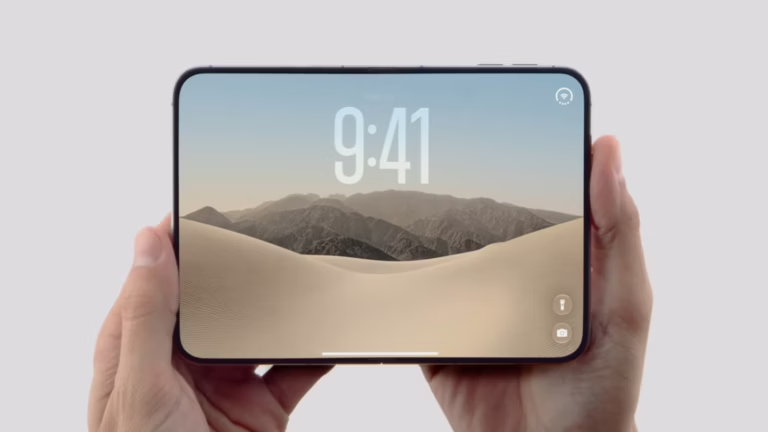
For seven generations, the Fold followed a familiar script: a tall, narrow cover screen that unfolds into a boxy, near-square tablet. The Z Fold 8 throws that out. It opens into a 7.6-inch, 2448 x 1848 display with a 4:3 aspect ratio — noticeably wider and shorter than any Fold before it — paired with a 5.5-inch, 1248 x 1972 cover screen in a 16:10 ratio that finally ditches the narrow “candy bar” look Samsung has used since the original Fold.
Both panels run at 120Hz, and the inner display uses Samsung’s new Flex Titanium substrate, which reviewers say makes the crease about as unnoticeable as it’s ever been on a Samsung foldable.
For comparison, the outgoing Z Fold 7 had a 6.5-inch cover screen and an 8-inch inner display — so this isn’t an incremental update, it’s a genuine fork in design philosophy. If you want the closer, taller successor to the Z Fold 7, that’s actually the Z Fold 8 Ultra, not this phone.
Design and Build
Despite the wider footprint, the Z Fold 8 is the lightest book-style foldable Samsung has ever made, at around 201 grams — lighter even than the Z Fold 7. It measures roughly 4.5mm thick unfolded. Reviewers who spent hands-on time with it describe it as genuinely comfortable to use one-handed, with the wider cover screen making typing and scrolling feel more natural than on past narrow-screened Folds.
Colors at launch
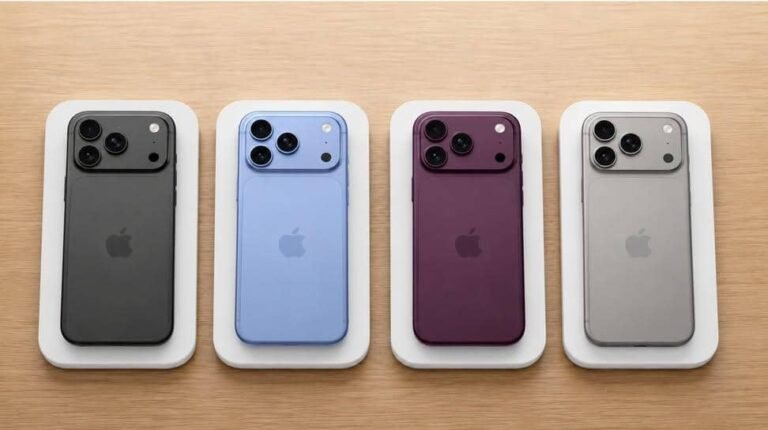
Graphite, Cream, and Lavender, with a fourth shade, Pistachio, exclusive to Samsung’s online store.
Performance and Software
The Z Fold 8 runs on Qualcomm’s Snapdragon 8 Elite Gen 5 for Galaxy chipset, the same silicon powering the Fold 8 Ultra and this year’s Galaxy S26 series. It’s paired with:
- 12GB RAM / 256GB or 512GB storage, or
- 16GB RAM / 1TB storage
No microSD support, as usual for the line. Early benchmarking has recorded AnTuTu scores in the 3.6-million range, putting it comfortably among this year’s fastest Android chipsets, and reviewers report smooth performance in everyday multitasking and gaming on the larger inner screen.
Software-wise, it ships with Android 17 and One UI 9, backed by Samsung’s commitment to up to seven years of major OS updates — matching its recent flagship policy. The full Galaxy AI suite is on board, including a new FanCam feature that auto-tracks and crops video for social media, plus Now Nudge, a contextual AI assistant feature. Samsung DeX, Knox security, and Samsung Health round out the software package.
Cameras
This is where the Z Fold 8 makes its clearest trade-off for the new form factor. It has a dual rear camera system:
- 50MP main, f/1.8
- 50MP ultrawide, f/1.9, 120°
Notably absent: any dedicated telephoto/zoom lens, which the Z Fold 8 Ultra retains. Front-facing, there are two 10MP, f/2.2 selfie cameras — one on the cover display, one on the inner screen — both capable of 4K video at 30/60fps.
Early hands-on testing describes the cameras as capable and consistent with Samsung’s well-established image processing, but reviewers are unanimous that if camera performance — especially zoom — is a top priority, the Z Fold 8 Ultra is the better choice.
Battery and Charging
Samsung has finally adopted silicon-carbon (Si/C) battery technology on the Fold line — a technology rivals have used for a few generations already. The Z Fold 8 packs a 4,800mAh Si/C battery, slightly smaller than the Fold 8 Ultra’s 5,000mAh cell, but the density gains from Si/C chemistry mean more usable capacity in a lighter package than a conventional battery of the same size.
Charging has also had a long-overdue upgrade:
- 45W wired charging (up from just 25W on the Z Fold 7), rated for roughly 63% in 30 minutes
- 20W wireless charging, plus reverse wireless charging
Samsung rates the Z Fold 8 for about 26 hours of video playback, just behind the Fold 8 Ultra’s 27-hour rating — a small enough gap that battery life between the two models is expected to feel nearly identical in daily use.
Connectivity
The Z Fold 8 ships with a complete flagship connectivity stack: 5G, Wi-Fi 7, Bluetooth 6.0 with aptX HD, NFC, eSIM support, UWB, and a side-mounted fingerprint reader. It does not include an IR blaster or a 3.5mm headphone jack (USB-C only), and it lacks official water-resistance certification at launch, per early spec listings.
Price and Availability
| Z Fold 8 | |
|---|---|
| Announced | July 22, 2026 |
| Release date | August 7, 2026 |
| Starting price | $1,899 / £1,699 (256GB) |
| Storage tiers | 256GB, 512GB, 1TB |
| Colors | Graphite, Cream, Lavender, Pistachio (online exclusive) |
Pre-orders are open now ahead of the August 7 release. For context, the Z Fold 8 Ultra starts at $2,099 and the Z Flip 8 starts at $1,199, both launching the same day.
Z Fold 8 vs. Z Fold 8 Ultra: Which Should You Buy?
| Z Fold 8 | Z Fold 8 Ultra | |
|---|---|---|
| Inner display | 7.6″, 4:3 | 8.0″, near-square |
| Cover display | 5.5″, 16:10 | 6.5″ |
| Cameras | Dual 50MP (no zoom) | Triple, incl. 200MP main + 3x telephoto |
| Battery | 4,800mAh | 5,000mAh |
| Starting price | $1,899 | $2,099 |
| Best for | Media, one-handed use, widescreen multitasking | Productivity, camera quality, taller multitasking |
The short version: the Z Fold 8 is the phone to pick if you want the boldest, most usable version of a foldable for everyday browsing, video, and one-handed use. The Z Fold 8 Ultra remains the better choice if camera quality and the familiar taller Fold layout matter more to you than novelty.
Early Verdict
Reviewers who got hands-on time ahead of and immediately after launch are largely enthusiastic. The consensus: this is the first Fold in years that feels like a genuine rethink rather than a yearly refresh, and the wider format could end up defining what Samsung foldables look like going forward. The compromises — no telephoto lens, a battery that’s merely good rather than class-leading, and a starting price just under $1,900 — are real, but reviewers largely agree they’re reasonable trade-offs for a phone this different.
Full in-depth reviews with extended battery and camera testing are still rolling in as the phone reaches more hands ahead of its August 7 street date, but early impressions point to the Galaxy Z Fold 8 being one of the most interesting foldables of the year.
Specs and pricing above reflect Samsung’s official Unpacked announcement on July 22, 2026, cross-checked against multiple hands-on reviews. Some figures (e.g., battery testing, full camera performance) are based on early impressions and may be updated as full reviews are published ahead of the August 7 retail launch.