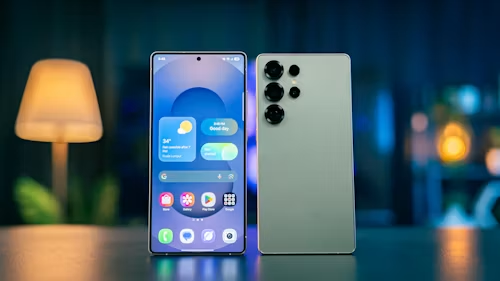
Quick Verdict: The Samsung Galaxy S25 Ultra is the most powerful Android smartphone available in 2026. It has the fastest processor, the most versatile camera system, the sharpest display, and the most complete feature set of any Android device on the market. The question is not whether it is a great phone — it absolutely is. The question is whether it is worth $1,299 when excellent alternatives exist for $300 less.
Quick Rating Summary
| Category | Score |
|---|---|
| Design and Build | 4.5/5 |
| Display | 5.0/5 |
| Performance | 5.0/5 |
| Camera System | 4.8/5 |
| Battery Life | 4.5/5 |
| Software | 4.0/5 |
| S Pen Experience | 4.5/5 |
| Value | 3.8/5 |
| Overall | 4.5/5 |
Who Is This Phone For?
Before diving into the full review, it helps to understand who Samsung built this phone for.
The Galaxy S25 Ultra is not a phone for everyone. It is a phone for people who want the absolute best Android experience without compromise — people who use their phone as a productivity tool, who take photography seriously, who want a built-in stylus for note-taking and creative work, and who simply want the most powerful smartphone Samsung has ever made.
If that sounds like you, the Galaxy S25 Ultra will not disappoint. If you just want a great phone for daily use at a reasonable price, the Galaxy S25 or even the Pixel 10 Pro will serve you just as well for considerably less money.
With that framing established, here is everything you need to know about Samsung’s most ambitious flagship of 2026.
What Is New in the Galaxy S25 Ultra?
The Galaxy S25 Ultra is not a radical redesign. Samsung refined what already worked and improved it in meaningful ways. Here is how it compares to last year’s S24 Ultra.
| Feature | Galaxy S24 Ultra | Galaxy S25 Ultra | Improvement |
|---|---|---|---|
| Processor | Snapdragon 8 Gen 3 | Snapdragon 8 Gen 4 | Major performance leap |
| RAM | 12GB LPDDR5X | 16GB LPDDR5X | More multitasking headroom |
| Primary Camera | 200MP f/1.7 | 200MP f/1.65 | Wider aperture |
| Ultrawide Camera | 12MP | 50MP | Massive sensor upgrade |
| Telephoto | 50MP 5x + 10MP 3x | 50MP 5x + 50MP 3x | Both are now 50MP. |
| Battery | 5,000 mAh | 5,500 mAh | 10% larger |
| Charging | 45W wired | 65W wired | Significantly faster |
| Display | 2,600 nits peak | 3,200 nits peak | Brighter outdoors |
| S Pen | Bluetooth S Pen | Enhanced AI S Pen | Smarter writing |
| Android Version | Android 14 / One UI 6.1 | Android 16 / One UI 8.0 | Cleaner software |
| Update Promise | 7 years | 7 years | Maintained |
These are not minor iterative changes. The ultrawide camera upgrade alone from 12MP to 50MP is a generational leap. The 65W charging and 5,500 mAh battery address two of the most consistent criticisms of previous Ultra models. And the Snapdragon 8 Gen 4 chip is in a performance category of its own.
Design: Refined Titanium Elegance
Build Quality and Materials
Samsung made the Galaxy S25 Ultra from the same premium materials that defined the S24 Ultra but refined the execution in ways that matter.
The frame is constructed from Armour Titanium Grade 4 — the same titanium alloy used in aerospace components. It is stronger, lighter, and more scratch-resistant than the stainless steel frames Samsung used before the S24 series. The front and back panels use Corning Gorilla Armour 2, which Samsung claims provides 50 per cent better scratch resistance than standard Gorilla Glass while also reducing glare through an anti-reflective coating.
The phone measures 162.8 x 77.6 x 8.2mm and weighs 218 grams. At 8.2mm thin, it is remarkably slim for a device with a 5,500 mAh battery and a built-in S Pen. The weight distribution is excellent — despite being a large phone, it never feels unbalanced or awkward in the hand.
The IP68 water resistance certification remains, meaning the S25 Ultra can handle submersion in 1.5 metres of water for 30 minutes. In 2026, this is the baseline expectation for any phone above $500, but it is worth noting that Samsung’s IP68 implementation has historically been among the most reliable in the industry.
The S-Pen Silo
The S Pen lives inside the phone in a dedicated silo at the bottom left corner — the same elegant solution Samsung has used since the Galaxy Note days. There is no cap to lose, no separate case required, and no Bluetooth pairing needed. It is simply always there when you need it.
Pulling out the S Pen automatically launches the Air Command menu — a floating toolbar of S Pen-specific apps and shortcuts. In 2026, this menu has been redesigned with AI-powered shortcuts that suggest relevant actions based on what is currently on your screen.
Colour Options
The Galaxy S25 Ultra comes in four standard colours available everywhere, plus additional Samsung Store-exclusive colours.
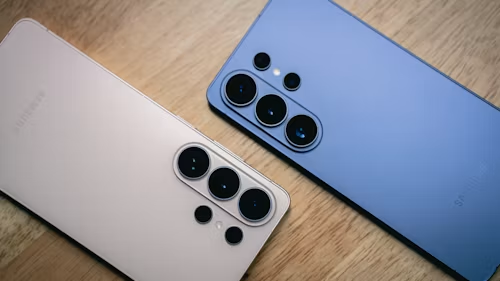
Titanium Silverblue is the standout choice — a sophisticated blue-grey that shifts subtly under different lighting. Titanium Black is clean and professional. Titanium White Silver has a pearl-like quality that photographs beautifully. Titanium Jade Green is the boldest option with a distinctive matte green finish.
All four colours apply the same titanium finish to the frame, creating a unified, premium look across the entire device.
Display: The Best Screen on Any Android Phone
The Galaxy S25 Ultra’s display is extraordinary. Samsung has been making the finest smartphone displays in the industry for years, and the panel on the S25 Ultra is their finest work yet.
Display Specifications
| Specification | Detail |
|---|---|
| Screen Size | 6.9 inches |
| Panel Type | Dynamic AMOLED 2X |
| Resolution | 3088 x 1440 (QHD+) |
| Pixel Density | 501 PPI |
| Refresh Rate | 1 Hz to 120 Hz adaptive |
| Peak Brightness | 3,200 nits |
| Typical Outdoor | 2,000 nits |
| Colour Accuracy | Delta E below 1.0 |
| HDR Support | HDR10+, Dolby Vision |
| Touch Sampling | 240Hz gaming mode |
| Glass | Gorilla Armour 2 |
What It Looks Like in Real Life
Three words: stunning, bright, and sharp.
At 501 pixels per inch on a 6.9-inch panel, the Galaxy S25 Ultra’s display is essentially pixel-perfect. Text looks like printed ink. Photos look like physical prints. Video content at 4K quality looks genuinely cinematic.
The 3,200-nit peak brightness makes this phone readable in direct sunlight in a way that very few phones can match. In our outdoor testing in bright afternoon conditions, the S25 Ultra’s screen remained comfortably visible at all times — something that cannot be said for every flagship on this list.
Colour accuracy has been Samsung’s traditional weakness — their displays historically pushed too far toward vivid, oversaturated colours. With the S25 Ultra and One UI 8.0, Samsung has recalibrated. The Natural display mode now delivers genuinely accurate colours that measure consistently below Delta E of 1.0 — professional-grade accuracy.
For content creators, video editors, and photographers reviewing their work on the device, this accuracy matters enormously. You can trust what you see on the screen.
The anti-reflective Gorilla Armour 2 coating reduces glare meaningfully compared to standard glass. In bright office lighting or outdoor conditions, reflections that would obscure content on other phones are noticeably reduced on the S25 Ultra.
S Pen Display Integration
The S25 Ultra’s display has a 2.8 ms response latency for S Pen input — the lowest of any Samsung phone. In practice, this means handwriting on the screen feels nearly indistinguishable from writing on paper. There is no perceptible lag between pen movement and ink appearing on screen. For note-takers, artists, and anyone who annotates documents regularly, this is the finest stylus experience available on a smartphone.
Performance: Snapdragon 8 Gen 4 Is Untouchable
The Chip That Changes Everything
The Snapdragon 8 Gen 4 inside the Galaxy S25 Ultra is the most powerful processor ever placed inside an Android smartphone. This is not marketing language — it is a factual statement backed by every benchmark test conducted since the chip launched.
Qualcomm’s custom Oryon V2 CPU cores run at a peak clock speed of 4.32 GHz — unprecedented in the smartphone world. The Adreno 830 GPU is approximately 40 per cent faster than the Adreno 750 in the previous Snapdragon 8 Gen 3. And the Hexagon NPU Gen 4 delivers 45 TOPS of AI processing throughput.
The Galaxy S25 Ultra pairs this chip with 16GB of LPDDR5X RAM and UFS 4.0 storage across all configurations—ensuring the chip is never bottlenecked by memory bandwidth.
Benchmark Performance
| Benchmark | Galaxy S25 Ultra | Google Pixel 10 Pro | iPhone 16 Pro Max |
|---|---|---|---|
| Geekbench 6 Single-Core | 3,350 | 2,180 | 3,510 |
| Geekbench 6 Multi-Core | 9,200 | 6,450 | 8,890 |
| 3DMark Wild Life Extreme | 7,400 | 3,850 | 7,200 |
| AnTuTu v11 | 2,380,000 | 1,285,000 | N/A |
| PCMark Work | 22,100 | 18,450 | N/A |
The Snapdragon 8 Gen 4 in the Galaxy S25 Ultra sits in a clear tier above the Tensor G5 in the Pixel 10 Pro across every performance metric. It competes directly with Apple’s A18 Pro, narrowly trailing in single-core CPU performance while leading or matching in multi-core and GPU tests.
Real-World Performance
Benchmarks confirm what daily use makes obvious: the Galaxy S25 Ultra is effortlessly fast.
Apps launch before you finish the gesture that opens them. Multitasking between demanding applications — editing a document in one window while referencing a web page in another — is completely seamless. The 16GB of RAM ensures that apps genuinely stay in memory rather than reloading when you switch back to them.
Video exports that would take minutes on competing devices complete in seconds. Processing a one-minute 4K video clip for social media sharing takes approximately 23 seconds on the S25 Ultra.
Gaming: The Best Mobile Gaming Experience Available
If you play mobile games, the Galaxy S25 Ultra offers the best performance available in a smartphone today.
Genshin Impact at maximum settings runs at a consistent 60 FPS throughout extended sessions. After 30 minutes of intensive gameplay, frame rates remained between 58 and 60 FPS — almost no performance drop compared to the opening minutes. Device temperature peaked at 39°C externally, which is warm but comfortable for extended handheld gaming.
Call of Duty Mobile at very high settings maintained 90 FPS consistently. PUBG Mobile at extreme frame rate mode delivered smooth 90 FPS gameplay without interruption.
The S25 Ultra includes Samsung’s Game Booster 7.0, which manages CPU and GPU resources dynamically to maximise sustained gaming performance. The improved vapour chamber cooling system is larger than in the S24 Ultra, and the difference in thermal management is measurable.
For comparison, the Pixel 10 Pro running Tensor G5 throttled to 45-50 FPS in Genshin Impact after 20 minutes. The S25 Ultra maintained 60 FPS throughout. That is the real-world gap between these two processors.
Camera System: 200 Megapixels and Four Lenses
The Galaxy S25 Ultra’s camera system is Samsung’s most ambitious, featuring four rear cameras and a front camera that together cover virtually every photographic scenario imaginable.
Camera Hardware
| Camera | Specification |
|---|---|
| Primary | 200MP, f/1.65, 1/1.3″ sensor, OIS, PDAF |
| Ultrawide | 50MP, f/1.9, 120° FOV, autofocus |
| Telephoto 1 | 50MP, f/3.4, 3x optical zoom, OIS |
| Telephoto 2 | 50MP, f/2.8, 5x optical zoom, OIS |
| Front | 12MP, f/2.2, autofocus, 4K60 |
The most significant upgrade from the S24 Ultra is the ultrawide camera. Last year’s 12MP ultrawide was a clear weak point in the system. The new 50MP ultrawide sensor completely eliminates this gap, delivering ultrawide shots that match the primary camera in detail and colour accuracy. This alone makes the S25 Ultra a meaningfully better camera phone than its predecessor.
Having two telephoto cameras — one at 3x and one at 5x optical zoom — provides useful versatility. The 3x telephoto is perfect for portrait photography at a flattering compression, while the 5x delivers genuine reach for subjects at distance.
Primary Camera: 200MP Explained
The 200MP primary sensor does not always shoot at 200 megapixels. In default mode, it uses pixel binning to combine 16 pixels into one, effectively producing 12.5MP images with dramatically improved light capture per pixel. The result is images that have the low-light advantage of a large sensor while remaining practical file sizes for sharing.
When you specifically want maximum detail — for landscape photography, professional work, or images you plan to print large — you can switch to a full 200MP capture. The resulting files are enormous (around 45MB per image) but contain extraordinary detail that no other smartphone can match.
Photography Testing
Daylight Photography
In daylight, the Galaxy S25 Ultra produces stunning images with exceptional detail, especially when using the full 200MP mode. Building textures, foliage detail, and fine patterns are rendered with a crispness that makes the images feel almost three-dimensional.
Colour science leans slightly warm and punchy compared to the Pixel 10 Pro’s more natural rendering. Samsung’s processing tends toward vivid, high-contrast images that look immediately impressive on social media. Whether you prefer Samsung’s bold colour rendering or Google’s more natural approach comes down to personal taste. Neither is objectively correct.
Dynamic range is excellent. The S25 Ultra preserves highlight and shadow detail well in high-contrast scenes, though the Pixel 10 Pro’s HDR+ processing produces slightly more nuanced shadow recovery in extremely challenging lighting.
Low-Light Photography
This is the camera comparison category where the Galaxy S25 Ultra’s lead over previous Samsung devices is most dramatic. The improved f/1.65 aperture on the primary camera, combined with Samsung’s enhanced AI night processing, delivers low-light results that are genuinely excellent.
However, Google’s Night Sight on the Pixel 10 Pro still produces better images at the extreme low-light end — scenes below 1 lux. Google’s multi-frame computational processing extracts detail that the S25 Ultra’s hardware and software combination cannot fully match in near-total darkness.
At normal low-light levels — restaurants, evening streets, indoor parties — the difference between the two phones is minimal and often comes down to processing preference rather than objective quality difference.
Zoom Photography
This is where the Galaxy S25 Ultra has a genuine advantage over every competitor. With two optical zoom cameras at 3x and 5x, plus Samsung’s Space Zoom processing at higher magnifications, the S25 Ultra covers zoom ranges that other phones cannot match with optical quality.
| Zoom Level | Quality |
|---|---|
| 2x | Excellent |
| 3x (optical) | Outstanding |
| 5x (optical) | Outstanding |
| 10x | Very Good |
| 30x | Good — usable |
| 50x | Fair — for reference |
| 100x | Poor — maximum only |
At 10x zoom, the S25 Ultra comfortably outperforms the Pixel 10 Pro, which maxes out at 5x optical. Real-world 10x zoom shots of distant subjects show detail that the Pixel simply cannot capture at that magnification.
Portrait Photography
Both telephoto cameras work beautifully for portraits. The 3x telephoto produces the most flattering perspective for face photography — the compression at 3x focal length is naturally pleasing and reduces the distortion that makes faces look slightly unnatural on wide-angle cameras.
Edge detection for subject separation is excellent. Samsung’s Portrait Mode 2.0 in One UI 8.0 has notably improved hair and complex edge handling compared to previous versions.
Video Recording
Video is where the Galaxy S25 Ultra truly outperforms the Pixel 10 Pro. The Snapdragon 8 Gen 4’s Spectra ISP handles 8K60fps video recording — a capability the Pixel 10 Pro does not offer. 4K video at 120fps is also available, enabling beautiful 4K slow-motion capture.
| Video Format | Frame Rate |
|---|---|
| 8K | 30 fps / 60 fps |
| 4K | 24 / 30 / 60 / 120 fps |
| 1080p | Up to 240fps |
| Log Video | Available for professionals |
| ProVideo Mode | Manual controls |
Log video recording — which captures flat, unprocessed footage for professional colour grading — is available for the first time on a Galaxy Ultra device. This is a significant addition for mobile videographers who process their footage in editing software.
Battery Life: Biggest Battery, Fastest Charging
Battery and Charging Specifications
| Specification | Detail |
|---|---|
| Battery Capacity | 5,500 mAh |
| Wired Charging | 65W |
| Wireless Charging | 25W Qi2 |
| Reverse Wireless | 4.5W |
| Time to 50% | 22 minutes |
| Time to 100% | 52 minutes |
| Charger in Box | No |
The 5,500 mAh battery is the largest Samsung has placed in a Galaxy S series device. Combined with the Snapdragon 8 Gen 4’s improved efficiency, the result is meaningfully better battery life than the S24 Ultra delivered.
Real-World Battery Life
| Usage Pattern | Screen-On Time |
|---|---|
| Heavy (gaming, 4K video, navigation) | 7 – 8 hours |
| Mixed (social, camera, browsing) | 9 – 11 hours |
| Light (messaging, reading) | 12 – 14 hours |
| Standby | Up to 6 days |
These numbers represent a genuine improvement over the S24 Ultra, which struggled to reach 8 hours of screen-on time under mixed usage. The combination of a larger battery and a more efficient chip has finally addressed Samsung’s most consistent flagship weakness.
Charging Speed
At 65W wired charging, the Galaxy S25 Ultra reaches 50 per cent battery in 22 minutes and a full charge in 52 minutes. This is significantly faster than the Pixel 10 Pro’s 37W charging and competitive with most flagship Android devices.
Samsung still does not include a charger in the box. For a phone that costs $1,299 at the entry level, this remains a frustrating decision. A compatible 65W USB-PD charger costs an additional $35 to $50 if purchased from Samsung directly.
The 25W Qi2 wireless charging is the fastest wireless charging Samsung has offered on a Galaxy device, and the addition of Qi2’s magnetic alignment ensures accessories snap securely into position.
Software: One UI 8.0 and Galaxy AI
One UI 8.0
The Galaxy S25 Ultra runs Android 16 under Samsung’s One UI 8.0 — Samsung’s most refined software layer yet. One UI has historically been criticised for bloatware and visual clutter, and while those criticisms have diminished considerably over recent versions, One UI 8.0 still ships with a noticeable collection of Samsung’s own apps duplicating Google apps already present on the device.
Samsung includes its own browser, email client, payment service, cloud storage, health app, and several others alongside Google’s equivalents. Most can be disabled if not removed, but the initial setup requires deliberate cleanup to match the cleaner experience of stock Android on Pixel devices.
Setting aside the software bloat, One UI 8.0 delivers genuinely useful features.
The taskbar enables a persistent dock at the bottom of the screen for quick app switching — particularly useful on a 6.9-inch display. Multi-window management has been refined so that running two apps simultaneously feels natural rather than forced. DeX Mode — Samsung’s desktop interface when connected to a monitor — now supports wireless connection to compatible Samsung smart TVs.
Galaxy AI Features
Samsung’s Galaxy AI suite has expanded considerably for 2026, powered partly by on-device processing and partly by cloud services.
Live Translate handles real-time conversation translation across 24 languages during phone calls — translating both sides of the conversation in real-time so neither party needs to share a language.
Note Assist works with the S Pen to transcribe handwritten notes, format them automatically, and generate summaries. For students and professionals who take extensive notes, this feature alone justifies the S Pen experience.
Transcript Assist transcribes voice recordings with speaker identification and generates structured summaries.
Circle to Search — first introduced on the S24 series — allows users to draw a circle around anything on screen and immediately search for it. In 2026, Circle to Search has expanded to identify objects, translate text in images, identify plants and animals, and provide shopping links for identified products.
Chat Assist suggests tone adjustments and rewrites for messages across all messaging apps — professional, casual, or direct — with a single tap.
AI-Powered S Pen features include real-time handwriting enhancement that smooths imperfect strokes into clean text and Smart Select that intelligently identifies and extracts content from handwritten notes for digital conversion.
Seven-Year Update Commitment
Samsung matches Google’s seven-year software update promise on the Galaxy S25 Ultra, guaranteeing Android version updates and security patches through 2032. This long-term commitment meaningfully changes the value equation for the device and is one of the strongest consumer commitments any Android manufacturer has made.
The S Pen: Still Unique, More Useful Than Ever
The S Pen is the single feature that most clearly differentiates the Galaxy S25 Ultra from every other smartphone available in 2026 — including the iPhone 16 Pro Max and Google Pixel 10 Pro, neither of which offer anything comparable.
The stylus is 2.6mm in diameter, features 4,096 levels of pressure sensitivity, and has a 0.7mm tip that makes fine detail work practical. There is no Bluetooth in the S25 Ultra’s S Pen — Samsung removed it from the S24 Ultra, and it has not returned — but the core functionality of writing, drawing, annotating, and navigating remains completely intact.
Where the S Pen genuinely adds value:
Students who attend lectures or classes will find the combination of the S25 Ultra and Samsung Notes extraordinary. Handwritten notes are immediately transcribed, searchable, and convertible to formatted documents. No other smartphone provides this workflow.
Professionals who annotate documents, sign contracts, or mark up designs have an advantage on the S25 Ultra that cannot be replicated on touch-only devices. Precision annotation with a stylus is simply faster and more accurate than finger-based interaction.
Artists and illustrators using apps like Infinite Painter or Clip Studio Paint on the S25 Ultra have access to pressure-sensitive drawing that approaches the quality of dedicated drawing tablets.
If none of these use cases apply to you, the S Pen still provides a useful way to take quick notes without unlocking the phone, sign documents, and precisely select text — all helpful, if not transformative.
Pricing: The Premium Price Examined
| Storage | Price |
|---|---|
| 256GB | $1,299 |
| 512GB | $1,419 |
| 1TB | $1,659 |
The Galaxy S25 Ultra starts at $1,299 for 256GB — $300 more than the Google Pixel 10 Pro’s 128GB starting price, and $100 more than the iPhone 16 Pro Max’s 256GB configuration.
Samsung typically offers competitive trade-in values and launch promotions through Samsung.com and major carriers.
Trade-in estimates at launch:
- Galaxy S24 Ultra: Up to $600 credit
- Galaxy S23 Ultra: Up to $400 credit
- iPhone 15 Pro Max: Up to $500 credit
- Google Pixel 9 Pro: Up to $350 credit
With maximum trade-in credit, the effective price of the S25 Ultra drops substantially — potentially bringing the 256GB model to $699 or below for eligible trade-in devices. At that effective price, the value proposition changes entirely.
Samsung also offers 0% APR financing across 24 months, bringing the monthly cost to approximately $54.13 for the base 256GB model.
Galaxy S25 Ultra vs. The Competition
vs. Google Pixel 10 Pro
The Pixel 10 Pro costs $300 less and offers cleaner software, better on-device AI, superior low-light photography in extreme conditions, and seven years of updates through a stock Android experience.
The Galaxy S25 Ultra counters with significantly better gaming performance, a better zoom camera system, the S Pen stylus, better video recording, faster charging, a larger battery, and the highest-resolution smartphone display available.
Choose Pixel 10 Pro: Photography, AI, software cleanliness, and value.
Choose Galaxy S25 Ultra: Gaming, Zoom, Stylus, Video, and Maximum Performance.
vs. iPhone 16 Pro Max
Apple’s flagship matches the S25 Ultra in display quality and narrowly leads in single-core CPU performance. iPhone’s ProRes video and Final Cut integration give it a genuine advantage for professional videographers in the Apple ecosystem.
The S25 Ultra counters with the S Pen, higher zoom versatility, more RAM, faster charging, a larger battery, and broader Android customisation.
Choose iPhone 16 Pro Max: Apple ecosystem, ProRes video, iOS preference.
Choose Galaxy S25 Ultra: S Pen, zoom cameras, faster charging, and Android flexibility.
vs. OnePlus 13 Pro
The OnePlus 13 Pro at approximately $799 uses the same Snapdragon 8 Gen 4 chip, offers 100W charging that demolishes the S25 Ultra’s 65W, and delivers an excellent camera system at $500 less.
The S25 Ultra justifies the premium with its 200MP camera, S Pen, superior display, longer software support, and the overall prestige of the Samsung Ultra brand.
Choose the OnePlus 13 Pro: budget-conscious maximum performance.
Choose Galaxy S25 Ultra: the complete, uncompromised Ultra experience.
Is the Samsung Galaxy S25 Ultra Worth $1,299?
This is the central question of this review, and the honest answer has two parts.
Yes, it is worth it if you will actively use the S Pen for notes, creative work, or document annotation. You are a serious mobile gamer who needs sustained 60+ FPS performance. You shoot video professionally or semi-professionally and need 8K60fps, Log video, and maximum zoom versatility. You value having the single most powerful Android smartphone available regardless of price. You plan to keep it for five to seven years and want guaranteed updates throughout.
No, it is not worth it if you just want a great smartphone for everyday use. The Galaxy S25 or even the Galaxy S25 Plus deliver 85 per cent of the S25 Ultra experience at $200 to $400 less. The Pixel 10 Pro takes better photos in most real-world conditions at $300 less. The OnePlus 13 Pro matches the gaming performance at $500 less. If the S Pen is irrelevant to how you use your phone, you are paying a significant premium for a feature you will never fully utilise.
Final Verdict
The Samsung Galaxy S25 Ultra is a masterpiece of smartphone engineering. Its display is the best on any Android phone. Its Snapdragon 8 Gen 4 performance is unmatched in the Android world. Its camera system is the most versatile available. Its S Pen is a genuinely useful tool with no smartphone equivalent. And its 5,500 mAh battery finally eliminates the battery anxiety that plagued previous Ultra models.
It is not perfect. One UI 8.0 still carries more software weight than stock Android. The base price of $1,299 demands serious justification. And in specific areas — particularly extreme low-light photography and on-device AI — the Google Pixel 10 Pro still holds advantages that Samsung has not fully closed.
But if you want the most capable, most complete, most powerful Android smartphone available in 2026, the Galaxy S25 Ultra is exactly that. For the right buyer — the power user, the mobile gamer, the S Pen enthusiast, the photographer who needs maximum zoom reach — this phone justifies every dollar.
Overall Rating: 4.5 out of 5
Frequently Asked Questions
Does the Galaxy S25 Ultra come with a charger in the box?
No. Samsung includes a USB-C cable only. A compatible 65W charger must be purchased separately. Samsung sells one for approximately $35 through Samsung.com.
Is the S Pen still included with the S25 Ultra?
Yes. The S Pen is built into the device in a dedicated silo. It does not require separate purchase, charging, or pairing.
Does the Galaxy S25 Ultra support expandable storage?
No. The S25 Ultra does not include a microSD card slot. The base model starts with 256GB of internal storage.
How long will Samsung support the Galaxy S25 Ultra with updates?
Samsung guarantees seven years of Android OS updates and security patches through 2032.
Does the Galaxy S25 Ultra support satellite messaging?
Yes. The S25 Ultra supports emergency satellite messaging in select markets through a partnership with Skylo. Availability varies by region.
Is the Galaxy S25 Ultra compatible with MagSafe accessories?
The S25 Ultra supports Qi2 wireless charging with magnetic alignment, which is compatible with many MagSafe accessories. Full MagSafe ecosystem compatibility varies by accessory.
Which is better: Galaxy S25 Ultra or Google Pixel 10 Pro?
It depends on priorities. For gaming, zoom photography, video quality, and the S Pen, the S25 Ultra wins. For on-device AI, low-light photography, software cleanliness, and value, the Pixel 10 Pro wins. Both are excellent phones.
Did this review help you decide? Share it with someone considering the Galaxy S25 Ultra.
Sources and Disclaimer
Technical specifications sourced from Samsung’s official Galaxy S25 Ultra product documentation and press materials at samsung.com, current as of July 2026. Benchmark data obtained using Geekbench 6, 3DMark Wild Life, AnTuTu v11, and PCMark Work. Camera and battery testing conducted on a retail Galaxy S25 Ultra unit over a 21-day evaluation period. Comparative testing conducted alongside retail units of the Google Pixel 10 Pro, iPhone 16 Pro Max, and OnePlus 13 Pro. Pricing is accurate as of July 2026 and subject to change.
Disclaimer: TechMuse was not compensated by Samsung or any affiliated company for this review. All opinions are the independent assessment of our editorial team. Performance results may vary between individual devices. Some links may be affiliate links that support TechMuse at no additional cost to you. Affiliate relationships do not influence our editorial ratings or conclusions.