Quick answer: Do not paste sensitive information into AI apps, review data-training settings, limit app permissions, use official applications, delete chat history when appropriate, and avoid connecting AI tools to accounts they do not need.
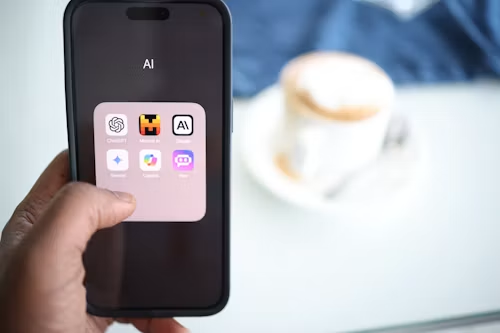
AI apps can summarize documents, write messages, analyze images, and automate tasks. They can also collect prompts, files, device information, and usage data depending on the service and your settings.
1. Use the official app or website
Download AI apps from the official app store or the provider’s verified website. Avoid unofficial tools that promise free access to paid models or ask you to sign in through suspicious pages.
Check the developer name, privacy policy, permissions, and reviews before installing.
2. Do not enter sensitive information
Avoid sharing:
- Passwords and verification codes
- Bank or payment details
- Identity documents
- Private medical information
- Confidential work files
- Client information
- Personal addresses
- Private conversations
- API keys and access tokens
If an AI tool needs information to help you, remove names, account numbers, addresses, and other identifying details first.
3. Review whether your chats are used for training
Many AI services provide settings that control chat history, model improvement, or training use. Open the privacy or data-control settings and review them carefully.
The names and options change over time. Do not assume that deleting a conversation automatically deletes every copy or stops future use. Read the provider’s current policy for details.
4. Limit app permissions
An AI app may request access to your microphone, camera, photos, contacts, location, files, or calendar.
Allow only what the feature requires. Choose “only while using” or limited photo access when available. Recheck permissions after major app updates.
5. Be careful with connected accounts
AI tools can sometimes connect to email, cloud storage, calendars, browsers, and work applications. These integrations can be useful, but they increase the amount of information the tool can access.
Before connecting an account, ask:
- Does the tool need full access?
- Can it edit or delete information?
- Does it require approval before taking action?
- Can access be revoked easily?
- Where is the connected data stored?
6. Use temporary or private modes when appropriate
If an AI service provides temporary chats, private sessions, or history controls, use them for sensitive but permitted questions. Remember that temporary mode is not a guarantee of absolute privacy.
Do not treat any AI service as a confidential vault unless its terms and security practices specifically support that use.
7. Remove identifying details before asking for help
Instead of writing:
Review this medical letter for John Mensah, account number 12345, living at [address].
Use:
Summarize this letter. Replace the person’s name and account number with placeholders.
Anonymisation reduces unnecessary exposure while preserving the useful context.
8. Check AI-generated results before sharing.
AI apps can produce incorrect information, reproduce private details, or include content from an uploaded file. Review the output before sending it to a client, colleague, school, or public audience.
Never rely on an AI response alone for medical, legal, financial, or security decisions.
9. Delete old data and connected apps.
Review your AI account regularly. Delete old conversations and uploaded files when appropriate. Remove integrations you no longer use and sign out of old devices.
For account security, use two-factor authentication and a unique password.
10. Be cautious with AI image and voice tools.
Photos, recordings, and voice samples can reveal faces, locations, identities, and other personal information. Do not upload someone else’s image or voice without permission, and understand how the service stores or uses uploaded media.
Final verdict
Use AI apps as helpful tools, not private storage spaces. Share the minimum information needed, review permissions and data settings, use official services, and keep sensitive personal or business information out of ordinary AI chats.