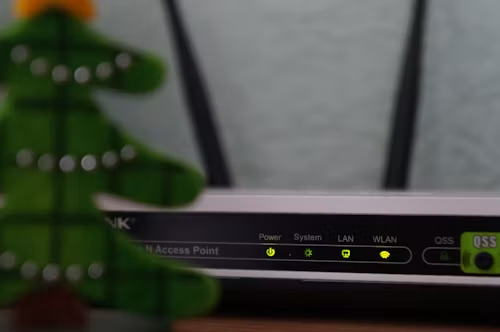
Quick answer: Move the router to a central, elevated location, remove obstructions, restart it, update its firmware, reduce interference, and consider a mesh system if the home is large or has thick walls.
A weak Wi-Fi signal can be caused by router placement, interference, distance, congestion, old hardware, or a problem with your internet provider. Try the simplest fixes first.
1. Move the router to a better location.
Place the router:
- Near the centre of the home
- On a shelf or elevated surface
- Away from thick walls and metal objects
- Away from microwaves and cordless-phone bases
- In an open area rather than inside a cabinet
Do not hide the router behind a television or in a closed cupboard.
2. Restart the router.
Unplug the router and modem, if separate. Wait about 30 seconds, reconnect the modem first, and then reconnect the router. Give the connection several minutes to return.
Restarting can fix temporary connection problems, but it does not improve the permanent range of the network.
3. Check whether the problem is Wi-Fi or the internet service.
Test the connection close to the router and then in the problem area. If speeds are good near the router but poor in another room, the issue is probably signal coverage.
If speeds are poor everywhere, contact your provider or check for an outage. Run a speed test at different times of day to identify congestion.
4. Use the correct Wi-Fi band.
Many routers offer 2.4 GHz and 5 GHz networks.
- 2.4 GHz: Longer range but usually slower and more vulnerable to interference.
- 5GHz: Faster at shorter distances but less effective through walls.
Use 5GHz near the router and 2.4GHz when range matters. Newer routers may also offer 6 GHz, which can be fast but has a shorter range and requires compatible devices.
5. Update the router.
Sign in to the router’s official administration page or app and check for firmware updates. Updates can improve stability and security.
Avoid downloading router firmware from unofficial websites.
6. Disconnect devices you do not use.
Old phones, smart-home products, streaming devices, and guest devices may continue using bandwidth. Disconnect equipment that is no longer needed and review the router’s connected-device list.
If you see an unknown device, change the Wi-Fi password and use WPA2 or WPA3 security where available.
7. Change the Wi-Fi channel if necessary.
In crowded buildings, nearby networks may interfere with one another. Many modern routers select channels automatically. If your router allows manual selection, use the least congested option or enable automatic channel selection.
Do not change advanced settings repeatedly without recording the original configuration.
8. Consider a mesh system or access point.
A mesh system can improve coverage in larger homes or buildings with thick walls. It is usually better than placing a basic repeater at the edge of an already weak signal.
If possible, connect mesh points or access points with Ethernet. A wired connection between points is generally more reliable than a wireless link.
9. Secure the network
Use a strong Wi-Fi password and change the default administrator password. Keep guest devices on a guest network when possible. For additional advice, read our guide to smart-home security.
When should you replace the router?
Consider replacing it if:
- It no longer receives security updates.
- It frequently disconnects or needs restarts.
- It does not support the speed you pay for.
- It cannot handle the number of devices in your home.
- It lacks modern security options.
Final verdict
Start with router placement, a restart, and a connection test before buying new equipment. If the home still has dead zones after these steps, a properly placed mesh system or wired access point is usually the most reliable upgrade.