Google Pixel 11 Review: A Strong, Iterative Upgrade Worth Taking Seriously
The Google Pixel 11 series is out, and early hands-on time from outlets who got units ahead of launch paints a consistent picture: this isn’t a dramatic reinvention, but it’s a genuinely solid, well-rounded upgrade with a few standout improvements worth knowing about before you buy. Here’s what the Pixel 11 is actually like to use.
Design and Build
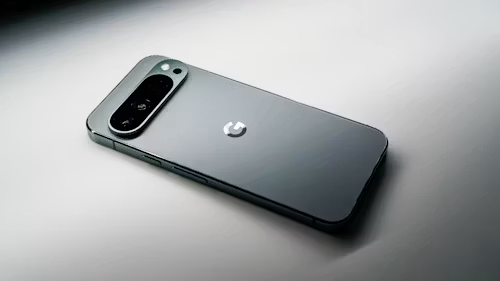
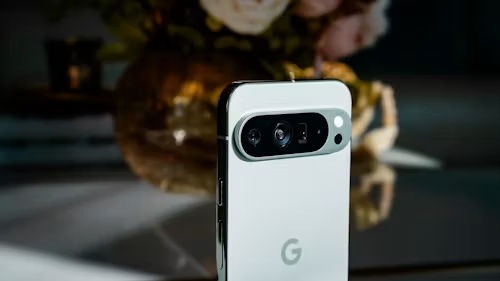
The Pixel 11 carries a slimmer camera bar than its predecessor despite housing a larger main sensor — a small but genuine engineering win. The Pro and Pro XL models introduce a new all-matte Obsidian colourway that early reviewers have singled out as a standout finish, a departure from the glossier look of recent generations. At 197 grams and 8.6mm thick, the standard Pixel 11 stays comfortably in familiar flagship territory for size and weight.
Display
All three non-foldable models share a 6.3-inch OLED panel, but the Pro and Pro XL step up to a brighter, LTPO-equipped Super Actua display capable of 3,600 nits peak brightness — the brightest screen Google has ever put in a Pixel. In practice, that translates to genuinely better outdoor visibility, one of the more consistently praised real-world improvements across early impressions.
Camera: The Clearest Upgrade This Generation
This is where the Pixel 11 series makes its strongest case. The Pro and Pro XL share an identical, meaningfully upgraded camera array: a new 50MP main sensor built specifically for better low-light capture, a redesigned 48MP telephoto pulling in roughly 30% more light than last year’s, and the same 48MP ultrawide. Early hands-on coverage has been genuinely enthusiastic here, with multiple outlets describing it as among the biggest camera upgrades Google has shipped in several generations.
The headline spec is 120x “Pro Zoom,” and it’s worth setting expectations correctly: reviewers testing it have been candid that at extreme zoom levels, you’re looking at heavy AI reconstruction filling in detail rather than optical capture — genuinely impressive as a tool, but worth understanding what it actually is before treating a 120x shot as a straightforward photograph.
The standard Pixel 11 gets a real, if more modest, upgrade too: the same 48MP main sensor now lets in roughly 56% more light, and the telephoto’s “Super Zoom” range grows from 20x to 30x. New software features across the lineup include Magic Capture, Instant Night Sight (up to 4.5x faster low-light capture), and Camera Looks for baked-in colour profiles at the point of shooting.
Performance: The Tensor G6
Every model ships with the new Tensor G6, and Google’s own claimed gains are specific rather than vague: 25% faster web browsing, 15% faster app launches, and a TPU handling on-device AI tasks up to 3.5x faster while using meaningfully less power. Early hands-on impressions describe all three phones as feeling fast and responsive, including while processing Magic Capture’s AI-assisted photo selection in real time — though independent lab benchmarks, which will be the real test of Google’s numbers, are still pending as of this writing.
Battery Life
Google hasn’t confirmed larger physical battery capacities this generation, but early testing points to real gains regardless — the Pixel 11 and both Pro models are reportedly lasting over 30 hours of mixed use, roughly six hours longer than the Pixel 10 generation. The Pixel 11 Pro Fold’s battery life is unchanged at around 24 hours.
Charging and Extras
The full lineup now supports Qi2.2 wireless charging at 25W through Google’s Pixelsnap magnetic system, a genuine speed upgrade over previous generations. Displays are also more scratch-resistant this year, and the Pro Fold specifically is rated at three times more durable than its predecessor.
Which Model Should You Actually Get?
Early hands-on comparisons have converged on a fairly consistent recommendation: the Pixel 11 Pro, not the Pro XL, as the sweet spot in the lineup. It shares the exact same camera system, the same 3,600-nit display, and the same HiLight rear LED as the Pro XL, while also gaining the faster Qi2.2 charging and a higher 256GB base storage tier — all for $200 less. Unless the Pro XL’s larger screen is something you specifically want, the standard Pro is the harder recommendation to argue against.
Where the Pixel 11 Falls Short
Camera and display upgrades aside, several early reviewers have been candid that this is fundamentally an iterative generation — new colours, meaningful but not category-defining camera gains, and better battery life, rather than a ground-up reinvention. If you already own a Pixel 10, the case for upgrading immediately is less compelling than it is for anyone coming from an older device.
Our Early Verdict
Based on extensive hands-on time from multiple outlets — though ahead of full independent lab benchmarking — the Pixel 11 series looks like a genuinely well-executed, if evolutionary, generation. The camera system is the clearest reason to be excited, the Tensor G6’s efficiency gains appear real, and the Pixel 11 Pro in particular looks like the smartest buy in the lineup.
For help deciding between the four models and current pricing, see our Pixel 11 buying guide. Curious how it stacks up against Apple’s current flagship? Check our Pixel 11 vs. iPhone 17 comparison.