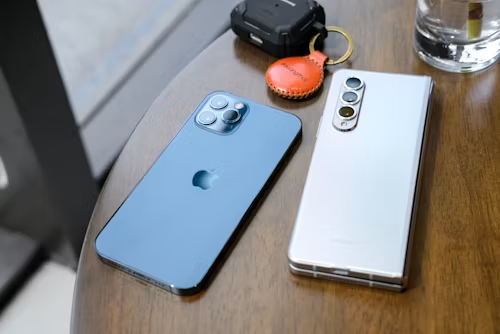
Two phones. Two ecosystems. One decision. The iPhone 17 and Samsung Galaxy S25 represent the absolute best that Apple and Samsung have to offer in 2026, and choosing between them is one of the most common dilemmas in consumer tech. This comparison breaks down every major category so you can make the right call for your needs, your budget, and the way you actually use your phone.
Design & Build Quality
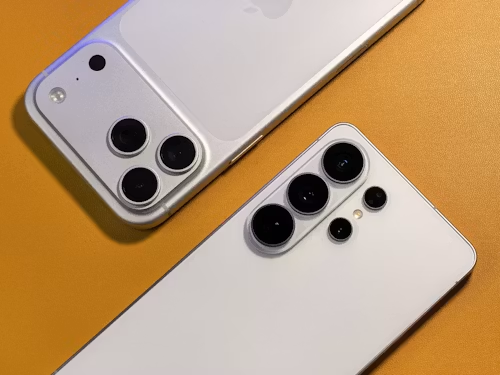
Both phones are exceptional in hand. The iPhone 17 introduces Apple’s thinnest bezels ever on a base model, a repositioned horizontal camera bar on the back, and an aluminium frame that feels solid and premium. Apple has also made the iPhone 17 slightly thinner than its predecessor, giving it a noticeably sleek profile.
The Samsung Galaxy S25 continues the refined design language Samsung introduced with the S24 — a flat display, titanium-grade frame, and Corning Gorilla Armour 2 glass front and back. It’s fractionally smaller than the iPhone 17 in every dimension, making it one of the most pocketable flagships available.
Winner: Tie. Both phones are beautifully built. iPhone 17 wins on thinness; Galaxy S25 wins on compactness.
Display
The iPhone 17 features a 6.1-inch Super Retina XDR OLED display with Apple’s ProMotion 120Hz adaptive refresh rate — finally coming to the base iPhone model. Peak brightness hits 2,000 nits, making it easily readable in direct sunlight.
The Samsung Galaxy S25 sports a 6.2-inch Dynamic AMOLED 2X display with a 120Hz adaptive refresh rate and peak brightness of 2,600 nits. Samsung’s display technology remains the industry benchmark — colours are vivid, contrast is deep, and the brightness advantage is noticeable in outdoor use.
Winner: Samsung Galaxy S25 — brighter, slightly larger, and Samsung’s display calibration remains best-in-class.
Performance
The iPhone 17 runs on Apple’s A19 chip — the fastest processor ever put into a base iPhone model and one of the fastest mobile chips ever made. Apple’s chip efficiency means the iPhone 17 handles everything from 4K video editing to intensive gaming without thermal throttling or slowdown.
The Galaxy S25 runs on the Snapdragon 8 Elite processor in most global markets — Qualcomm’s most powerful chip to date. It delivers exceptional performance across all workloads and is the fastest Android chip available in 2026.
In real-world use, both phones are extraordinarily fast. Benchmarks give the A19 a raw performance edge, but the Snapdragon 8 Elite is close enough that most users will never notice a difference in everyday tasks.
Winner: iPhone 17 — Apple’s chip efficiency and raw performance lead is measurable, even if it’s rarely felt in daily use.
Camera System
The iPhone 17 receives Apple’s most significant base model camera upgrade in years. The main sensor is a new 48MP Fusion camera with second-generation sensor-shift optical image stabilisation. The front camera gets a massive upgrade to 48MP — up from 12MP on the iPhone 16 — and Apple introduces 4K 120fps video recording on the iPhone 17 for the first time.
The Samsung Galaxy S25 features a triple camera setup — a 50MP main sensor, a 12MP ultrawide, and a 10MP 3x telephoto lens. Samsung’s computational photography produces vivid, punchy images that many users prefer for social media content. The telephoto lens gives the S25 a clear advantage in zoom photography over the base iPhone 17, which lacks a dedicated telephoto camera.
Winner: Samsung Galaxy S25 for versatility (telephoto lens); iPhone 17 for video quality and front camera.
Battery Life & Charging
The iPhone 17 carries a larger battery than its predecessor and Apple claims up to 22 hours of video playback. Real-world use delivers a comfortable full day for most users. Charging speeds remain a relative weakness — 30W wired and 25W MagSafe wireless.
The Galaxy S25 packs a 4,000mAh battery with 25W wired charging and 15W wireless charging. Battery life is comparable to the iPhone 17 in real-world use, though Samsung’s charging speeds have been criticised for lagging behind Chinese Android competitors at this price point.
Winner: Tie — both phones deliver similar real-world battery life with similar charging limitations.
Software
iOS 18 on the iPhone 17 is polished, intuitive, and deeply integrated with the Apple ecosystem. If you already use a Mac, iPad, Apple Watch, or AirPods, the iPhone 17 makes that entire ecosystem work together seamlessly. Apple Intelligence — Apple’s on-device AI system — is deeply embedded throughout iOS 18.
Android 15 with One UI 7 on the Galaxy S25 is Samsung’s most refined software experience to date. Galaxy AI features are genuinely useful — live translation, note summarisation, and Circle to Search make the S25 feel like a forward-thinking device. Samsung promises seven years of OS updates on the S25, matching Apple’s long-term support commitment.
Winner: Depends on your ecosystem. iPhone 17 for Apple users; Galaxy S25 for Android users or those who want more customisation.
Price
Both phones start at similar price points in the $799–$899 range depending on storage configuration and market.
Final Verdict
Choose the iPhone 17 if you’re already in the Apple ecosystem, prioritise video quality and chip performance, or want the smoothest software experience available on any smartphone.
Choose the Samsung Galaxy S25 if you want a brighter display, a more versatile camera system with telephoto zoom, or prefer Android’s flexibility and customisation.
There is no wrong answer here — both phones are exceptional. The decision ultimately comes down to which ecosystem feels like home.
Disclosure: TechMuse may earn a commission from purchases made through affiliate links in this article at no extra cost to you.