Google Pixel 11 is officially Here: A Game-Changing Launch, fully confirmed
Google has officially unveiled the Pixel 11 series at its Made by Google event in New York, and the lineup is now confirmed — no more leaks, no more hedging. Four phones, a genuinely faster chip, and a redesigned camera bar headline a launch that Google is positioning squarely around Gemini AI. Here’s everything confirmed.
The Lineup
Google introduced four phones: the Pixel 11, Pixel 11 Pro, Pixel 11 Pro XL, and the book-style Pixel 11 Pro Fold. Pre-orders opened immediately after the announcement, with wide availability starting August 20, 2026 — one week earlier in the calendar than the Pixel 10 launch the year before. Google used the same event to introduce the Pixel Watch 5 alongside the phone lineup.
Tensor G6: A Real, Measured Performance Jump
Google’s new Tensor G6 chip, built on a 2 nm manufacturing process, is the technical centrepiece of this launch. Google is claiming concrete, specific gains rather than vague marketing language: a 25% faster web browsing experience, 15% quicker app launches, and a dedicated TPU that processes on-device AI tasks up to 3.5x faster while using 3.5x less energy than the previous generation. Paired with the Titan M3 security co-processor, this stands as Google’s most substantial chip generation-over-generation leap in years.
Pricing: Official and Higher Across the Board
Confirmed US pricing:
- Pixel 11: $899 (256GB) — up from the Pixel 10’s $799, with 128GB storage tiers eliminated entirely across the lineup and a new 512GB option added at $1,019
- Pixel 11 Pro: $1,099 (256GB)
- Pixel 11 Pro XL: $1,299 (256GB) — a $100 increase over the previous generation
- Pixel 11 Pro Fold: pricing confirmed separately, starting around $1,899
In Europe, the Pixel 11 starts at €999. Google’s own framing acknowledges the increase directly, tying it to camera upgrades, durability improvements, and the new Tensor G6 — though it’s worth noting this tracks with the broader memory chip shortage pushing prices up industry-wide in 2026, not something unique to Google.
One genuine silver lining buried in the pricing change: since 256GB is now the standard starting tier across the board (rather than a paid upgrade from 128GB), buyers are getting meaningfully more baseline storage for their money than the sticker price increase alone suggests.
Cameras: A Redesigned Bar, New Software Tricks
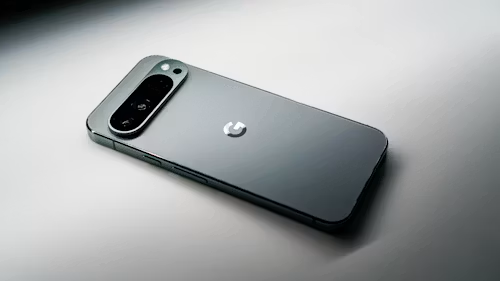
The camera bar itself has been redesigned with a shinier, glass-clad finish, and Google is leading with a new computational feature called Magic Capture across the camera experience. One notable hardware change: Google has dropped the rear-facing temperature sensor that appeared on recent Pro and Pro XL generations, reportedly to make room for the phone’s new lighting system.
Pixel HiLight: The New Design Signature
Confirming earlier leaks, the Pro models now feature Pixel HiLight, a new LED lighting element built into the back of the phone. Google is positioning it as both a functional notification indicator and a design statement — how it behaves in daily use is the kind of detail that becomes clearer once reviewers spend real time with the hardware.
Display: Pixel 11 vs. Pixel 11 Pro
The standard Pixel 11 carries a 6.3-inch Actua OLED display with an in-display fingerprint scanner and full 5G support, measuring 152.8 x 72 x 8.6mm and weighing 197 grams. Step up to the Pixel 11 Pro and you get a 6.3-inch Super Actua OLED LTPO panel instead — same physical size, but a sharper 2856 x 1280 resolution, adaptive 1-120 Hz refresh rate, peak brightness up to an impressive 3,600 nits, and Gorilla Glass Victus 2 protection. Both are powered by the Tensor G6 and Titan M3, with the Pro offering 12GB or 16GB RAM configurations.
Charging: A Genuine Upgrade
Both the Pixel 11 and Pixel 11 Pro now support Qi2.2 wireless charging at 25W, a real speed upgrade over previous Pixel generations. Google’s Pixelsnap magnetic charging system — carried over from the Pixel 10 — also remains compatible with most existing MagSafe accessories, meaning owners of Apple-ecosystem magnetic chargers and mounts aren’t necessarily locked out.
Gemini and Software
Google has been explicit that this generation was “designed for Gemini “Intelligence”—the framing throughout the announcement leaned heavily on proactive, agentic AI assistance rather than simple voice commands. Combined with the Tensor G6’s dramatically faster on-device AI processing, this stands as Google’s strongest argument yet for AI as the reason to choose a Pixel.
What This Means for Your Buying Decision
Weighing whether the Pixel 11 is worth it comes down to a few genuinely solid points: the Tensor G6’s claimed gains are specific and measurable rather than vague, the storage baseline improved even as prices rose, and the Qi2.2 charging and display upgrades on the Pro model are real, tangible improvements — not just incremental spec bumps. Independent benchmarks and hands-on reviews remain the real test of Google’s performance claims and are worth checking before you commit if you want the full picture beyond Google’s own numbers.
For help deciding which specific model fits your needs and budget, see our Pixel 11 buying guide, and if you’re weighing it against Apple’s current flagship, check our Pixel 11 vs. iPhone 17 comparison.