Quick Verdict: The iPhone 16 Pro Max and Samsung Galaxy S25 Ultra represent the absolute peak of smartphone engineering in 2026. They take fundamentally different approaches to the same goal: delivering the best possible mobile experience. The iPhone wins on ecosystem integration, consistent performance, and video capability. The Galaxy wins on hardware versatility, zoom photography, and charging speed. After weeks of side-by-side testing, here is everything you need to know to choose correctly.
Quick Ratings Comparison
| Category | iPhone 16 Pro Max | Galaxy S25 Ultra | Winner |
|---|---|---|---|
| Design and Build | 4.5/5 | 4.5/5 | Tie |
| Display | 5.0/5 | 5.0/5 | Tie |
| Performance | 5.0/5 | 5.0/5 | Tie |
| Camera System | 4.8/5 | 4.8/5 | Tie |
| Battery Life | 4.5/5 | 4.5/5 | Tie |
| Charging Speed | 3.0/5 | 5.0/5 | Galaxy S25 Ultra |
| Software and AI | 4.5/5 | 4.0/5 | iPhone |
| Ecosystem | 5.0/5 | 3.5/5 | iPhone |
| Value | 4.0/5 | 3.8/5 | iPhone |
| Overall | 4.7/5 | 4.5/5 | iPhone 16 Pro Max |
Why This Comparison Matters in 2026
For most of smartphone history, the question “Should I buy an iPhone or a Samsung?” was the central purchasing decision for premium phone buyers. The Galaxy S25 Ultra and iPhone 16 Pro Max continue this tradition in 2026, representing the very best of their respective platforms.
These are not just two phones. They are two complete philosophies about what a smartphone should be. Apple believes in deep vertical integration — controlling the chip, the operating system, the camera processing, and the ecosystem to create a seamless, consistent experience. Samsung believes in hardware versatility—packing in the most advanced components, using the fastest chips, and giving users more choice and flexibility through Android’s open platform.
Both philosophies produce exceptional results. Our goal in this comparison is to help you understand which philosophy better matches how you actually use your phone.
We tested both devices extensively over a three-week period in real-world conditions—daily work, photography in various lighting scenarios, gaming, media consumption, productivity, and travel. Here is our honest, detailed assessment.
Design and Build: Premium Materials, Different Approaches
iPhone 16 Pro Max Design
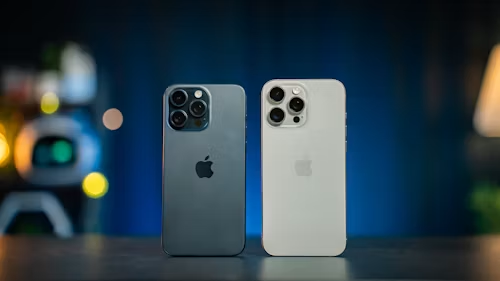
The iPhone 16 Pro Max uses a Grade 5 titanium frame with a matte finish that resists fingerprints remarkably well. The front has Apple’s proprietary Ceramic Shield glass, which Apple claims is the toughest glass in any smartphone. The back is a textured matte glass that provides solid grip without feeling slippery.
The device measures 163.0 x 77.6 x 8.25mm and weighs 227 grams. It is the largest iPhone Apple has made, and in 2026, it remains a substantial device that may require two-handed use for users with smaller hands.
The most distinctive hardware addition is the camera control button—a capacitive control on the right edge dedicated to camera functions. It enables one-handed adjustment of zoom, exposure, and camera settings. After six months of iOS 26 software refinement, it is a genuinely useful tool for photographers, though casual users may rarely touch it.
The Action Button replaces the traditional mute switch and can be customized to trigger shortcuts, launch apps, or control accessibility features. iOS 26 has significantly expanded the list of assignable functions, making this button genuinely versatile.
Galaxy S25 Ultra Design
The Galaxy S25 Ultra uses Armor Titanium Grade 4 for its frame—aerospace-grade titanium that Samsung claims provides a superior strength-to-weight ratio. The front and back use Corning Gorilla Armor 2, which combines scratch resistance with a remarkable anti-reflective coating that dramatically reduces glare in bright environments.
The device measures 162.8 x 77.6 x 8.2 mm and weighs 218 grams—essentially the same dimensions as the iPhone but 9 grams lighter. The weight distribution is excellent, with the phone feeling balanced and comfortable despite its size.
Samsung’s signature S Pen stylus is built directly into the phone in a dedicated silo. No separate purchase. No charging required. It is always available when needed and represents a functional capability that no iPhone offers at any price point.
The dedicated camera button on the right edge provides similar functionality to Apple’s Camera Control, enabling press, hold, and swipe interactions for different camera functions without touching the screen.
Which Design Is Better?
This is genuinely a tie. Both devices are masterpieces of industrial design with premium materials, excellent grip, and distinctive visual identities.
The iPhone feels more refined and minimalist. The Galaxy feels more purposeful and feature-dense. The S Pen gives the Galaxy a functional advantage that no iPhone can replicate. The Camera Control button provides similar photographic benefits on both platforms.
Your choice here comes down to aesthetic preference and whether you value the S Pen experience.
Design Winner: Tie
Display: Two Exceptional Screens, Two Different Priorities
iPhone 16 Pro Max Display Specifications
| Specification | Detail |
|---|---|
| Screen Size | 6.9 inches |
| Panel Type | LTPO Super Retina XDR OLED |
| Resolution | 2868 x 1320 pixels |
| Pixel Density | 460 PPI |
| Refresh Rate | 1Hz – 120Hz ProMotion |
| Peak Brightness | 2,000 nits typical, 4,000 nits peak HDR |
| HDR Support | HDR10, Dolby Vision, HLG |
| Always-On Display | Yes |
| Glass Protection | Ceramic Shield |
Galaxy S25 Ultra Display Specifications
| Specification | Detail |
|---|---|
| Screen Size | 6.9 inches |
| Panel Type | Dynamic AMOLED 2X |
| Resolution | 3088 x 1440 (QHD+) |
| Pixel Density | 501 PPI |
| Refresh Rate | 1 Hz – 120 Hz adaptive |
| Peak Brightness | 3,200 nits peak |
| HDR Support | HDR10+, Dolby Vision |
| Touch Sampling | 240Hz gaming mode |
| Glass Protection | Gorilla Armor 2 |
Side-by-Side Display Testing
These are the two finest smartphone displays available in 2026, but they excel in different ways.
Brightness: The Galaxy S25 Ultra’s 3,200 nits peak brightness gives it a measurable advantage in direct sunlight. In our outdoor testing across bright summer conditions, the Galaxy’s screen remained consistently more readable in harsh sunlight. The iPhone’s 4,000 nits peak HDR brightness is extraordinary for HDR content playback, but its typical outdoor brightness of 2,000 nits sits below the Galaxy’s ceiling for everyday use.
Pixel Density: The Galaxy’s 501 PPI versus the iPhone’s 460 PPI is technically measurable and makes the Galaxy’s display slightly sharper when reading very small text or fine detail. Realistically, both are so sharp that the difference is nearly impossible to perceive without magnification during normal use.
Color Accuracy: Both displays are professionally calibrated with Delta E values below 1.0 in their accurate color modes. The iPhone tends toward slightly cooler, more neutral tones consistent with Apple’s natural color science philosophy. The Galaxy offers more adjustment options through Samsung’s display settings, including vivid and natural modes with granular user control.
Anti-Reflective Coating: This is one of the most significant practical differences between the two screens. Gorilla Armor 2 on the Galaxy S25 Ultra dramatically reduces glare and reflections compared to the iPhone’s Ceramic Shield. In bright environments—offices with overhead lighting, outdoors, or near windows—the Galaxy’s display is materially more viewable because reflections are suppressed far more effectively.
Gaming and Touch Response: The Galaxy’s 240Hz touch sampling rate gives it a slight perceived responsiveness advantage in competitive mobile games where milliseconds matter. The iPhone’s 120Hz ProMotion remains buttery smooth for all everyday use.
Display Winner: Galaxy S25 Ultra
The Galaxy S25 Ultra’s display wins by a narrow but real margin, primarily due to its higher sustained outdoor brightness and dramatically better anti-reflective coating. Both are exceptional screens, but Samsung’s panel is more usable in challenging real-world lighting conditions.
Performance: Two Different Kinds of Speed
A18 Pro vs. Snapdragon 8 Gen 4
| Benchmark | iPhone 16 Pro Max | Galaxy S25 Ultra | Winner |
|---|---|---|---|
| Geekbench 6 Single-Core | 3,510 | 3,350 | iPhone |
| Geekbench 6 Multi-Core | 8,890 | 9,200 | Galaxy |
| 3DMark Wild Life Extreme | 7,200 | 7,400 | Galaxy |
| AnTuTu v11 | N/A | 2,380,000 | Galaxy |
| Sustained Load Degradation | 6% | 8% | iPhone |
| Peak External Temperature | 38°C | 39°C | iPhone |
These benchmark results paint a nuanced picture. The iPhone wins on single-core CPU performance — the metric that matters most for app launch speed and day-to-day task responsiveness. The Galaxy wins on multi-core and GPU performance — the metrics that matter most for intensive multi-threaded workloads and sustained gaming.
Real-World Performance Testing
In daily use—app launching, social media, web browsing, messaging, and photography—both phones perform identically from a user perspective. You cannot feel the difference between these two devices for standard smartphone tasks. Both are instant, fluid, and responsive in a way that makes direct comparison largely academic.
Gaming: The Galaxy S25 Ultra sustained higher frame rates in our 30-minute gaming tests across Genshin Impact at maximum settings. The Adreno 830 GPU provides approximately 10 percent higher sustained gaming performance than the A18 Pro’s Apple-designed GPU under heavy thermal load. For the most demanding games, the Galaxy is the better-performing device on a pure frame rate basis.
However, the iPhone’s exclusive AAA game library — including Death Stranding, Resident Evil Village, Assassin’s Creed Mirage, and a growing roster of console ports — provides access to experiences that no Android device offers. If you want the most graphically intensive console-quality games available on mobile, the iPhone’s exclusive software advantage matters more than raw GPU benchmark numbers.
Productivity: For video editing, document processing, and heavy multitasking, both phones are exceptionally capable. The iPhone’s ProRes Log recording and Final Cut Pro integration give it a clear productivity advantage for video professionals specifically. The Galaxy’s larger 16GB RAM allocation provides a practical advantage for keeping more apps actively loaded in memory simultaneously.
Performance Winner: Tie
For typical users, the performance difference is imperceptible in daily use. For mobile gamers who prioritize raw frame rates, the Galaxy has the edge. For professional video creators, the iPhone has the edge. Both devices are substantially overpowered for everyday use and will remain fast for years to come.
Camera Systems: The Closest Competition in Smartphone Photography
Camera Hardware Comparison
| Camera | iPhone 16 Pro Max | Galaxy S25 Ultra |
|---|---|---|
| Primary | 48MP f/1.78, 1/1.28″ sensor | 200MP f/1.65, 1/1.3″ sensor |
| Ultrawide | 48MP f/2.2, 120° FOV | 50MP f/1.9, 120° FOV |
| Telephoto 1 | 12MP 5x f/2.8 tetraprism | 50MP 5x f/2.8 |
| Telephoto 2 | None | 50MP 3x f/3.4 |
| Front | 12MP f/1.9, autofocus | 12MP f/2.2 |
Primary Camera: Real-World Results
Daylight Photography
Both phones produce exceptional daylight images. The Galaxy’s 200MP sensor captures more native detail, though the iPhone’s 48MP primary is already more than sufficient for any practical photographic purpose, including large-format printing. Color science differs significantly between the two—the iPhone produces cooler, more neutral, more analytically accurate tones, while the Galaxy produces warmer, more vibrant, more immediately striking images.
No objective winner exists here — it is genuinely a matter of photographic taste and intended use. Photography professionals often prefer the iPhone’s neutral rendering because it provides more flexibility in post-processing. Social media users and casual photographers often prefer the Galaxy’s vivid output because images look impressive without any editing whatsoever.
Low-Light Photography
This is where the two phones diverge most noticeably in hardware terms. The Galaxy S25 Ultra’s wider f/1.65 aperture captures more light than the iPhone’s f/1.78. In independent testing at 1 lux illumination — equivalent to a very dimly lit room — the Galaxy produced marginally brighter images with slightly more detail in deep shadows. However, the iPhone’s processing pipeline produces more natural noise management and better color accuracy in complex mixed lighting scenarios.
The Galaxy excels at capturing maximum available light. The iPhone excels at processing that light in a way that looks natural rather than artificially processed. Both approaches produce excellent results; preference depends on which output you find more appealing.
Portrait Photography
Both phones produce excellent portrait photography. The iPhone’s portrait processing is slightly more consistent in subject edge detection, particularly around complex subjects like hair in backlit conditions. The Galaxy offers more manual adjustment options before and after capture. The Galaxy’s dedicated 3x telephoto provides a more naturally flattering focal length for face photography than the iPhone’s interpolated 3x zoom from the primary sensor—a genuine hardware advantage for portrait shooters.
Zoom Photography: Clear Galaxy Advantage
This is the most clear-cut camera difference between the two phones.
| Zoom Level | iPhone 16 Pro Max | Galaxy S25 Ultra |
|---|---|---|
| 2x | Excellent (primary crop) | Excellent (primary crop) |
| 3x | Good (interpolated) | Outstanding (optical) |
| 5x | Outstanding (optical) | Outstanding (optical) |
| 10x | Good | Very Good |
| 30x | Fair | Good |
| 100x | Poor | Fair |
The Galaxy S25 Ultra’s two dedicated telephoto lenses—3x and 5x optical—give it a fundamental hardware advantage that software cannot bridge. At every zoom level above 2x, the Galaxy produces better, more detailed images. At 3x specifically—the most commonly used zoom range for portrait and detail photography—the difference is significant because the Galaxy has a dedicated optical lens at that focal length while the iPhone relies on interpolation.
Video: Clear iPhone Advantage
This is where the iPhone fully asserts its camera dominance in a way that hardware specifications alone do not capture.
| Video Capability | iPhone 16 Pro Max | Galaxy S25 Ultra |
|---|---|---|
| Maximum Resolution | 4K ProRes up to 60fps | 8K up to 60fps |
| Log Video | Yes (ProRes Log) | Yes |
| Dolby Vision | Yes, up to 120 fps. | Yes |
| Cinematic Mode | Yes (with focus editing) | Limited |
| Spatial Video | Yes (for Apple Vision Pro) | No |
| Professional Workflow | Final Cut Pro integration | Limited |
| Audio Recording | Studio-quality directional | Good |
The iPhone 16 Pro Max remains the finest video camera available on any smartphone in July 2026. Its stabilization is class-leading, its color consistency across all cameras during switching is unmatched, and its ProRes Log workflow—from capture in the native camera app to editing in Final Cut Pro on iPhone or Mac—creates a complete professional video production pipeline that no Android device can replicate.
Spatial Video capture for Apple Vision Pro viewing remains exclusively available on iPhone—a feature that becomes more relevant as the Vision Pro ecosystem grows and more users invest in spatial media creation.
For videographers, content creators, documentary filmmakers, and professional media producers, the iPhone 16 Pro Max is the clear camera winner.
Camera Winner by Use Case
Photography — especially zoom: Galaxy S25 Ultra
Videography and professional content: iPhone 16 Pro Max
General daily photography: Tie—both are exceptional with different aesthetic approaches
Battery Life and Charging: The Galaxy’s Most Convincing Victory
Battery Specification Comparison
| Specification | iPhone 16 Pro Max | Galaxy S25 Ultra |
|---|---|---|
| Battery Capacity | 4,685 mAh | 5,500 mAh |
| Wired Charging | 27W | 65W |
| Wireless Charging | 25W MagSafe | 25W Qi2 |
| Reverse Wireless | No | 4.5W |
| Charger in Box | No | No |
| Time to 50% | ~35 minutes | ~22 minutes |
| Time to 100% | ~100 minutes | ~52 minutes |
Real-World Battery Life Comparison
| Usage Pattern | iPhone 16 Pro Max | Galaxy S25 Ultra |
|---|---|---|
| Heavy | 8 – 9 hours | 7 – 8 hours |
| Mixed | 11 – 13 hours | 9 – 11 hours |
| Light | 14 – 16 hours | 12 – 14 hours |
| Standby | Up to 7 days | Up to 6 days |
Despite having a smaller physical battery, the iPhone 16 Pro Max delivers better real-world battery life per charge in every usage category. This reflects the A18 Pro chip’s superior power efficiency and iOS 26’s aggressive, intelligent background management. The iPhone simply does more with less battery capacity.
However, the Galaxy’s 65W charging completely transforms the daily recharging experience. A 15-minute charge adds approximately 50 to 60 percent battery — enough to comfortably complete a full remaining workday. A full charge takes 52 minutes versus the iPhone’s 100 minutes. This practical recharging flexibility matters enormously for users who forget to charge overnight or need quick top-ups throughout the day.
When you pair the substantially faster charging with reverse wireless charging for accessories like the Galaxy Watch and Galaxy Buds, the Galaxy’s overall energy management experience is more versatile for heavy users who prioritize flexibility over per-charge endurance.
Battery Winner: Galaxy S25 Ultra
The combination of substantially faster wired charging, equivalent wireless charging, and reverse wireless charging for accessories gives the Galaxy a clear practical energy advantage. The iPhone’s superior per-charge battery life is a genuine strength but is undermined significantly by its frustratingly slow charging speed for a $1,199 device.
Software and AI: iOS 26 vs. One UI 8.0
iOS 26 with Apple Intelligence
The iPhone 16 Pro Max runs iOS 26—Apple’s current mobile operating system that shipped with the iPhone 16 series in September 2025 and has received four significant updates through July 2026, with iOS 26.5 representing the current version.
Apple’s software approach is built on two principles: privacy-first on-device processing and seamless integration across Apple’s hardware ecosystem. Every Apple Intelligence feature defaults to on-device computation through the A18 Pro’s neural engine, with cloud AI available as an optional extension for more complex queries.
Key Apple Intelligence Features in iOS 26:
Writing Tools are available system-wide across every app—Mail, Messages, Notes, third-party apps—enabling proofreading, rewriting, tone adjustment, and text summarization without leaving whatever you are working in.
Priority Notifications use AI trained on personal behavior patterns to surface genuinely important alerts and batch lower-priority notifications, reducing interruptions meaningfully after approximately two weeks of learning.
Clean Up in Photos removes unwanted objects from images using AI-generated background reconstruction. The implementation has improved dramatically through iOS 26 updates and handles most everyday use cases reliably.
Visual Intelligence allows the camera to identify objects, plants, animals, businesses, products, and text in the real world, providing contextual information linked directly to Maps, Safari, and third-party apps.
Siri with Contextual Awareness—the iOS 26.5 overhaul introduced a Siri capable of maintaining conversation threads, understanding references to previous queries, and executing multi-step actions across multiple apps in a single request.
ChatGPT and Gemini Integration—Apple introduced both ChatGPT and optionally Gemini as cloud AI backends for complex queries that exceed on-device Siri capabilities, providing powerful AI responses without requiring separate apps.
One UI 8.0 with Galaxy AI
The Galaxy S25 Ultra runs Android 16 under Samsung’s One UI 8.0—Samsung’s most refined and capable software version yet, though it still carries more pre-installed applications and Samsung service duplication than most users need.
Key Galaxy AI Features in One UI 8.0:
Live Translate handles real-time conversation translation during active phone calls in 24 languages — translating both sides of a conversation simultaneously so neither party needs to share a common language. This feature has no direct iPhone equivalent.
Note Assist works with the S Pen to transcribe handwritten notes, automatically format them into structured documents, and generate concise summaries. For students and professionals who take extensive handwritten notes, this is transformative.
Circle to Search—now a standard Galaxy feature—allows users to draw a circle around any content on screen to immediately search for it, identify it, translate it, or find it for purchase.
Chat Assist suggests tone adjustments, rewrites, and clarity improvements for messages across all apps with a single tap.
AI-powered S Pen features include real-time handwriting smoothing that converts imperfect strokes into clean, legible text and intelligent content extraction from handwritten notes.
Composer generates written content — emails, messages, social posts — from brief prompts across all messaging and productivity applications.
Software Comparison Analysis
Apple Intelligence on iOS 26 feels more cohesive, more privacy-respecting, and more elegantly integrated into the operating system. The iOS 26.5 Siri overhaul addressed the most significant weakness in the Apple AI experience, and the system now handles complex multi-step requests reliably.
Galaxy AI on One UI 8.0 offers more feature breadth in certain categories — particularly multilingual translation and S Pen-specific AI capabilities that have no iPhone equivalent. However, One UI 8.0 still carries duplicate Samsung apps alongside Google equivalents, requiring deliberate cleanup to achieve a streamlined experience.
For users who value software cleanliness and privacy-first AI processing, iOS 26 is the superior platform. For users who want maximum AI feature breadth and the unique S Pen AI workflow, One UI 8.0 provides capabilities iOS cannot match.
Software Winner: iPhone 16 Pro Max
iOS 26 is more polished and more privacy-preserving, and Apple Intelligence integration feels more unified and purposeful. One UI 8.0 is Samsung’s best software yet but still trails in overall refinement and software economy.
Ecosystem: The iPhone’s Unmatched Competitive Advantage
The ecosystem comparison between these two phones is not close, and it may be the single most important factor in your purchasing decision.
Apple Ecosystem Depth
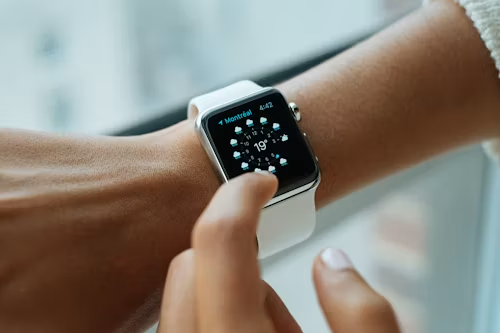
The Apple Watch remains the most capable and medically relevant smartwatch available in 2026, with features including ECG monitoring, blood oxygen tracking, fall detection, crash detection, and the latest glucose trend monitoring on supported models. Its integration with iPhone, Health app, Messages, and emergency services creates a safety and wellness ecosystem that Samsung’s Galaxy Watch cannot fully match.
AirPods connect automatically to every Apple device the moment you pull them from their case, switching seamlessly between iPhone, Mac, iPad, and Apple Watch based on where audio is playing. The experience of earbuds that simply work across every device without manual switching is genuinely impressive.
AirDrop transfers files between Apple devices at Wi-Fi speeds with zero configuration — select a file, tap the recipient’s name, done. No app required. No account needed.
iPhone Mirroring, introduced in iOS 26, allows complete control of your iPhone directly from a Mac screen—running iPhone apps, responding to notifications, and managing the phone without picking it up.
Handoff allows starting an email, document, or web browsing session on iPhone and continuing exactly where you left off on Mac or iPad, with zero friction.
Continuity Camera turns the iPhone into a professional-grade webcam for Mac video calls automatically when the iPhone is positioned near the Mac.
Final Cut Pro for iPhone brings Apple’s professional video editing software — the same application used by professional filmmakers and broadcast television — to the iPhone screen, creating a complete professional video pipeline from capture to final export.
iMessage remains culturally dominant in North America, with features including high-resolution media, reactions, satellite messaging, and deep iOS integration that SMS and third-party messaging apps cannot replicate within the Apple ecosystem.
Samsung Ecosystem Reality
Samsung has invested significantly in building its own ecosystem, but the depth and seamlessness of integration still lag behind Apple’s.
Galaxy Watch integration with the S25 Ultra is excellent — the reverse wireless charging from phone to watch, unified health data in Samsung Health, and Galaxy AI features that extend to the watch create a genuinely useful pairing. But the Galaxy Watch’s health features, third-party app library, and cross-device intelligence remain behind the Apple Watch’s equivalent capabilities.
Galaxy Buds are excellent earbuds with strong noise cancellation and good sound quality. Device switching between Samsung devices is smooth but requires more manual interaction than AirPods with Apple devices.
Samsung DeX is a genuine Galaxy exclusive that the iPhone cannot match—connecting the S25 Ultra to a monitor produces a full desktop computing environment with a PC-style interface. For users who want their phone to occasionally replace a computer, DeX is a compelling capability.
Samsung SmartThings provides smart home integration for Samsung and compatible devices, but the ecosystem is narrower than Apple HomeKit for users with existing smart home investments.
Ecosystem Winner: iPhone 16 Pro Max—and it is not close
For users already owning an Apple Watch, AirPods, a MacBook, or an iPad, the iPhone 16 Pro Max is the only logical choice. The daily convenience of seamless cross-device integration creates a quality-of-life advantage that no specification comparison can quantify but every Apple ecosystem user experiences constantly.
Pricing: How the Value Equation Compares in July 2026
| Storage | iPhone 16 Pro Max | Galaxy S25 Ultra |
|---|---|---|
| 256GB | $1,199 (MSRP) | $1,299 (MSRP) |
| 512GB | $1,399 (MSRP) | $1,419 (MSRP) |
| 1TB | $1,599 (MSRP) | $1,659 (MSRP) |
Current Street Prices in July 2026:
| Model | Street Price Range |
|---|---|
| iPhone 16 Pro Max 256GB | $1,099 – $1,149 |
| Galaxy S25 Ultra 256GB | $1,199 – $1,249 |
Six months after launch, street prices have adjusted across major retailers, including Amazon, Best Buy, and carrier storefronts. The iPhone 16 Pro Max now costs approximately $100 less than the Galaxy S25 Ultra at street price — a reversal of their relative positioning at launch when both were effectively equal in real-world pricing.
Trade-in Values Available in July 2026:
For iPhone 16 Pro Max through Apple:
- iPhone 15 Pro Max: Up to $630 credit
- iPhone 14 Pro Max: Up to $450 credit
- Samsung Galaxy S24 Ultra switching to iPhone: Up to $400 credit
For Galaxy S25 Ultra through Samsung:
- Galaxy S24 Ultra: Up to $600 credit
- Galaxy S23 Ultra: Up to $400 credit
- iPhone 15 Pro Max switching to Samsung: Up to $500 credit
Both manufacturers offer competitive trade-in promotions that can significantly reduce the effective out-of-pocket cost. Financing through the Apple Store and Samsung.com both offer 0% APR across 24 months.
Value Winner: iPhone 16 Pro Max
At current street prices, the iPhone 16 Pro Max is approximately $100 less expensive than the Galaxy S25 Ultra for equivalent storage. Combined with the Apple ecosystem advantages, this pricing advantage makes the iPhone the better overall value for most buyers.
Which Flagship Should You Actually Buy?
Choose the iPhone 16 Pro Max If You
Already own other Apple products. If you have an Apple Watch, AirPods, a MacBook, or an iPad, the iPhone 16 Pro Max is not just the better choice — it is the only choice that makes rational sense for your daily life. The ecosystem integration creates convenience that no specification sheet can fully capture.
Want the best video camera available on any phone. ProRes Log recording, Cinematic Mode with post-capture focus editing, and Final Cut Pro for iPhone create a professional video workflow that no Android phone offers.
Prefer a clean, refined, and privacy-respecting software experience. iOS 26 is the more polished platform with fewer unnecessary apps, more coherent AI integration, and stronger on-device privacy protection.
Value the growing AAA console game library. Death Stranding, Resident Evil Village, Resident Evil 4 Remake, and Assassin’s Creed Mirage on iPhone offer console-quality gaming experiences unavailable on Android.
Want the best possible battery endurance per charge for all-day use without recharging.
Plan to keep your phone for five or more years and want the most reliable long-term software support track record in the industry.
Choose the Galaxy S25 Ultra If You
Use or intend to use the S Pen regularly. For note-taking, document annotation, digital art, or precise text selection, the S Pen is a transformative capability that no iPhone can replicate at any price.
Care about zoom photography versatility. The dual telephoto system at 3x and 5x optical zoom covers photographic scenarios that the iPhone’s single 5x telephoto cannot match, particularly portrait photography at 3x.
Want the fastest available charging on a premium flagship. At 65W, the Galaxy charges fully in 52 minutes compared to the iPhone’s 100 minutes. For users with busy lives who frequently need quick top-ups, this is a real daily quality-of-life difference.
Play demanding mobile games extensively. The Snapdragon 8 Gen 4’s Adreno 830 GPU sustains higher frame rates in demanding games over extended sessions.
Prefer Android’s customization, openness, and flexibility over iOS’s polished consistency.
Need Samsung DeX for phone-to-desktop computing functionality.
What If You Are Genuinely Undecided?
Consider your current device ecosystem before anything else. Switching from an established platform always carries real costs—new accessories, lost integrations, and unfamiliar workflows. If you own an Apple Watch, switching to Android means replacing your watch or losing most of its functionality. If you own Samsung earbuds and a Galaxy Watch, switching to iPhone means losing the deep integration those devices have with Android.
After the ecosystem, consider the S Pen. If note-taking, drawing, or precise stylus input appeals to you genuinely, the Galaxy S25 Ultra is the only smartphone offering that experience. If the S Pen is irrelevant to how you use your phone, you are paying a meaningful premium for a feature you will likely never fully utilize.
Finally, consider charging. If slow charging genuinely frustrates you in daily life, the Galaxy’s 65W charging is transformatively better than the iPhone’s 27W. If you primarily charge overnight and never feel rushed, the iPhone’s superior per-charge battery life matters more.
The Independent Verdict
After extensive side-by-side testing across every category that matters to real users, two clear conclusions emerge.
The Galaxy S25 Ultra is the more complete hardware package. It has the better display for outdoor use, faster charging, a more versatile zoom camera system, the unique S Pen, a larger battery, and better sustained GPU performance for gaming. On pure hardware specification and versatility, the Galaxy S25 Ultra is the most feature-complete Android smartphone ever made.
The iPhone 16 Pro Max delivers the more refined and valuable overall experience. Its A18 Pro chip maintains class-leading efficiency, its video capabilities are unmatched on any smartphone, iOS 26 with Apple Intelligence is more polished and privacy-respecting than any Android platform, its ecosystem integration with other Apple devices creates daily value that hardware specifications cannot quantify, and its per-charge battery endurance exceeds every Android alternative.
For most people — and particularly for anyone already invested in the Apple ecosystem — the iPhone 16 Pro Max is the better flagship to buy in 2026. The seamless daily experience across devices, the exceptional and maturing Apple Intelligence capabilities on iOS 26, the professional video workflow, and the natural, consistent user experience create a quality of life that raw specifications alone do not convey.
For users who genuinely value the S Pen, need the most flexible zoom camera system available, play demanding games for extended daily sessions, and want the fastest possible recharging, the Galaxy S25 Ultra is the better phone for their specific needs and will not disappoint.
The most reassuring conclusion is this: whichever you choose, you are getting one of the two best smartphones ever made. In 2026, both flagships are extraordinary achievements that will serve their owners excellently for years to come. The real winner of this comparison is any buyer fortunate enough to own either one.
Frequently Asked Questions
Which phone has the better camera overall?
For zoom photography and hardware-based image capture versatility, the Galaxy S25 Ultra wins with its dual telephoto lenses. For video recording, stabilization, and professional video workflows, the iPhone 16 Pro Max wins decisively. For general daily photography in daylight, both are excellent with different approaches to color science and processing.
Which phone gets better battery life?
The iPhone 16 Pro Max delivers longer real-world battery life per charge in every usage category, consistently lasting 15 to 20 percent longer than the Galaxy S25 Ultra in mixed usage. However, the Galaxy’s 65W charging means it can be recharged much more quickly, making the combined battery and charging experience more flexible for users who frequently need fast top-ups.
Should I switch from iPhone to Galaxy or vice versa?
Think very carefully about ecosystem investment before switching platforms. If you own an Apple Watch, AirPods, or a MacBook, switching to Android carries genuine daily costs in lost integration. If you use a Samsung Galaxy Watch and Galaxy Buds, switching to an iPhone reduces the functionality of those accessories. The devices are comparable in overall quality — your decision should be driven by ecosystem loyalty, the S Pen, and specific feature priorities rather than performance differences that most users will never perceive.
Which phone is better for long-term use through 2030 and beyond?
Both phones benefit from exceptional software longevity commitments. Apple guarantees iOS updates for at least five to six years with historical evidence of longer support. Samsung guarantees seven full years of Android OS updates and security patches for the S25 Ultra through 2032. Both phones are excellent long-term investments.
Which is the better gaming phone?
The Galaxy S25 Ultra sustains higher frame rates in demanding mobile games thanks to the Snapdragon 8 Gen 4’s GPU advantage under thermal load. However, the iPhone’s exclusive AAA game library — including console-quality ports of Resident Evil, Death Stranding, and Assassin’s Creed — provides gaming experiences that simply do not exist on Android regardless of hardware capability.
Does the Galaxy S25 Ultra still include the S Pen?
Yes. The S Pen is permanently integrated into the phone body and requires no separate purchase, charging, or pairing. It is available instantly by pulling it from its silo and provides 4,096 levels of pressure sensitivity with 2.8ms input latency.
Should I wait for the iPhone 17 Pro Max instead?
If you can wait until September 2026, the iPhone 17 Pro Max is approximately eight weeks away. It is expected to bring a new A19 Pro chip, camera improvements, and a refined design. If you need a phone now, the iPhone 16 Pro Max remains an excellent purchase. If you are not in a rush and are considering an iPhone, waiting eight weeks is a reasonable strategy.
Did this comparison help you make your decision? Share this article with someone choosing between these two flagships. Drop your questions in the TechMuse comments below—we read and respond to every one.
More From TechMuse
Samsung Galaxy S25 Ultra Review — Is It Worth the Premium Price in 2026?
iPhone 16 Pro Max Review — Six Months Later, Still Worth Buying?
Google Pixel 10 Pro Review — The Best Android Phone of 2026?
Best Android Phones of 2026 — Every Flagship Ranked
iPhone 17 Pro Max — Everything We Know So Far
Sources and Disclaimer
Technical specifications and pricing data sourced from Apple.com and Samsung.com official product documentation, iOS 26 release notes versions 26.0 through 26.5, and manufacturer press materials current as of July 2026. Benchmark results from Geekbench 6, 3DMark Wild Life Extreme, and AnTuTu v11. Testing conducted on retail units of the iPhone 16 Pro Max and Samsung Galaxy S25 Ultra over a 21-day comparison period. Battery testing used PCMark battery benchmark alongside real-world timed usage sessions. Camera comparisons conducted across multiple shooting scenarios and lighting conditions in controlled and real-world environments. Comparative performance data cross-referenced with IDC and Counterpoint Research smartphone market analysis as of July 2026.
Disclaimer: TechMuse was not compensated by Apple, Samsung, or any affiliated company for this comparison. All opinions are the independent assessment of our editorial team. Performance results may vary between individual devices and software versions. Some links may be affiliate links supporting TechMuse at no additional cost to you. Affiliate relationships do not influence editorial ratings or conclusions. Pricing is accurate as of July 2026 and subject to change.