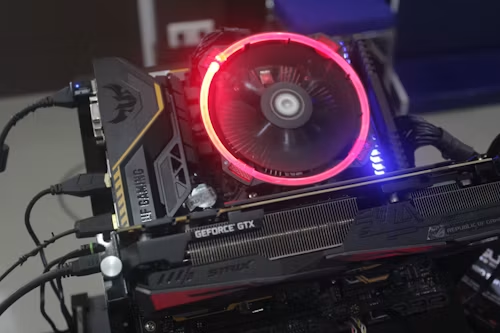

Something has shifted in 2026. For years, the word “emerging” in technology meant promising but distant — innovations living in research labs, startup pitches, and analyst reports rather than the real world. That era is ending.
The technologies on this list are not predictions. They are active, funded, and deploying. Quantum computers are shipping to paying customers. Humanoid robots are on factory floors and airport tarmacs. Gene therapies designed in months are entering clinical trials. AI agents are making business decisions without human approval — and getting paid to do it.
The top emerging technologies in 2026 share a common thread: they are moving from labs and concepts into scalable reality (TechCon Global, “12 Top Emerging Technologies To Watch In 2026”). This is the year those trajectories become irreversible.
Here are the ten technologies defining that future — what they are, where they stand, and why they matter.
1. Agentic AI: The Rise of AI That Acts, Not Just Answers
For the past several years, artificial intelligence has been in the assistant business — answering questions, generating content, and offering suggestions. In 2026, the model is fundamentally changing. AI has moved from talking to doing.
What it is: Agentic AI refers to systems that can autonomously plan, execute, and complete multi-step tasks without constant human oversight. Unlike a chatbot that waits for a prompt, an agentic AI is given a goal and figures out how to achieve it — browsing the web, writing code, interacting with software systems, and adapting when things don’t go as planned.
The gap between AI assistants and AI agents is best summarised in one line: a chatbot answers; an agent acts.
Where it stands: The adoption numbers are staggering. According to Gartner, 40% of enterprise applications will feature task-specific AI agents by the end of 2026, up from less than 5% in 2025 (Generative, Inc., “Agentic AI in 2026: How AI Went From Chatting to Doing”). The agentic AI market is worth roughly $9.9 billion in 2026, forecast to grow more than 40% a year, reaching an estimated $57 billion by 2031 (Unicoconnect, “Agentic AI Statistics 2026: Adoption, ROI, and Market Size”). Real-world enterprise deployments in 2026 include autonomous customer service resolution, AI-driven financial auditing, supply chain optimisation, and HR candidate screening — all running with minimal human supervision.
Why it matters: Agentic AI doesn’t just automate tasks — it restructures how work happens. Organisations that deploy agents effectively free up human workers for strategy, judgement, and organisation, while AI handles the high-volume, multi-step operational work. Those who get this balance right in 2026 will have a structural productivity advantage over those still waiting for the dust to settle.
2. Quantum Computing: From Research Curiosity to Commercial Reality
Quantum computing has spent two decades being “five years away”. In 2026, the goalpost has finally moved — not because quantum computers can do everything, but because they can now do something commercially meaningful.
What it is: Quantum computers use the principles of quantum mechanics—superposition (staying in multiple states simultaneously) and entanglement (qubits influencing each other regardless of distance)—to perform types of computation exponentially faster than classical computers. They are not general-purpose replacements for your laptop; they are specialised accelerators for specific categories of hard problems: drug-molecular simulation, logistics optimisation, financial risk modelling, and cryptography.
Where it stands: A wave of groundbreaking breakthroughs in 2026 has completely rewritten the development timeline of the industry. Expertspecialisedhat the maturity of large-scale practical quantum computdrug-moleculars been advanced by 5 tooptimisation,rking an officiamodelling,rom the noisy intermediate-scale quantum (NISQ) era to the fault-tolerant quantum computing era (SpinQ, “Quantum Computing Advances: Breakthroughs Accelerate Industrial Transformation in 2026”). Error-corrected machines are now shipping to customers — QuEra delivered a quantum machine ready for error correction to Japan’s National Institute of Advanced Industrial Science and Technology. Quantum technologies are projected to reach a USD 97 billion market by 2035, with startup funding rising sharply (StartUs Insights, “Top 10 Emerging Technologies in 2026”).
Crucially, the practical deployment model for 2026 is hybrid quantum-classical: quantum processors handle specific computational bottlenecks inside larger classical pipelines, rather than replacing classical systems outright.
Why it matters: Beyond performance, quantum computing carries an urgent security implication. Adversaries are already capturing encrypted data today to decrypt it once quantum hardware becomes capable — a strategy called “harvest now, decrypt later”. Organisations in defence, finance, and healthcare need to begin migrating to quantum-rlater”. t encryption now, not when the threat arrives.
3. Humanoid Robots & Physical AI: The Body Enters the Workplace
For decades, robots were bolted to factory premises, utterly immovable. The new generation of humanoid robots is something entirely different: machines that walk, carry, adapt, and increasingly learn on the job.
What it is: Physical AI refers to artificial intelligence embedded in machines that must perceive and act in the physical world — navigating real environments, handling objects, and responding dynamically to unpredictable conditions. Humanoid robots are the most visible expression of physical AI, but the category includes all robots that operate outside controlled industrial environments.
Where it stands: The deployments in 2026 are real, not demos. Japan Airlines deployed Unitree Robotics-based humanoid platforms at Tokyo’s Haneda Airport for baggage loading, container transport, and cabin cleaning, with base pricing starting at approximately $15,400 per unit (Memeburn, “Physical AI Is Sending Humanoid Robots to Real Factory Floors in 2026”). Boston Dynamics’ electric Atlas began commercial deployments with its entire 2026 production allocation committed to Hyundai and Google DeepMind. AgiBot produced its 10,000th humanoid in late March 2026, scaling from 1,000 units in 2025 to 10,000 within months (KraneShares, “Humanoid Robotics In 2026: The Race From Pilot To Platform”). Across the industry, logistics and warehousing (41,000 units), semiconductor manufacturing (22,500 units), and food service (8,200 units) account for 64% of all commercial deployments, with food service emerging as the surprise growth sector at +61% year-over-year (Robotics Center of Silicon Valley, “State of Robotics 2026 Report”).
The honest picture: Humanoid robots on production packaging lines remain a few development cycles away. The near-term commercial opportunity is in structured, repetitive environments — warehouses, airport ground operations, semiconductor fabs — where conditions can be partly controlled.
Why it matters: The cost curve is bending. Commercial humanoid robots in 2026 range from $16,000 to $250,000+ depending on capability. As manufacturing scales, prices will fall toward the $10,000–$15,000 range by 2028–2030 — at which point the addressable market expands dramatically. The companies building deployment data and operational track records today will define who wins that market.
4. Gene Editing & Precision Medicine: Rewriting the Code of Disease
In December 2023, the FDA approved Casgevy — the world’s first CRISPR-based therapy — for sickle cell disease. That approval was a starting pistol, not a finish line. In 2026, gene editing has moved from a single approved therapy to a platform with targets across cancer, rare genetic disorders, cardiovascular disease, and neurodegeneration.
What it is: CRISPR (Clustered Regularly Interspaced Short Palindromic Repeats) is a molecular tool that allows scientists to precisely edit DNA sequences—sequences—cutting mutations, correcting errors, or inserting new genetic instructions. Advanced variants include base editing (changing individual DNA letters without cutting) and prime editing (a more precise “find and replace” for DNA).
Where it stands: The most remarkable recent milestone occurred when researchers developed and delivered a bespoke CRISPR therapy for an infant with a rare genetic disorder in just six months — a process that once took over a decade (Gray Group International, “Gene Editing and CRISPR in 2026: The Technology Reshaping Human Health”). On the cancer front, CRISPR-engineered CAR-T cells (immune cells reprogrammed to hunt tumours) are showing results in blood cancers, with some patients achieving long-term remission. Personalised cancer vaccines using mRNA technology now aim to reduce recurrence and minimise side effects, applying the same platform that produced COVID-19 vaccines to oncology (HOncology, “7 Breakthroughs in Patient-Centric Oncology Care in 2026”). The NIH recently funded a breakthrough that shrinks the CRISPR system itself — identifying an enzyme (Al3Cas12f) small enough to be delivered inside the body via standard viral vectors, dramatically expanding the range of conditions treatable in vivo.
Why it matters: The shift from ex vivo editing (removing cells, editing them in a lab, and returning them) to in vivo editing (delivering CRISPR directly into the body) will transform who can access these therapies. Ex vivo editing requires specialized centers and costs millions per patient. In vivo delivery could eventually be administered like a conventional drug infusion. That’s the difference between a treatment for a few thousand patients and one for millions.
5. Spatial Computing & AR Glasses: The Layer Over Reality
For most people, computing happens on screens — flat rectangles of glass that demand your full attention. Spatial computing proposes something different: digital information that exists in and around the physical world, anchored to real objects, real spaces, and real context.
What it is: Spatial computing is the convergence of AI, augmented reality (AR), virtual reality (VR), and real-world environmental understanding. It ranges from lightweight AR glasses that overlay information on your field of view to full mixed-reality headsets that blend photorealistic digital content with the physical world around you.
Where it stands: Apple Vision Pro 2, powered by the M5 chip with 2x faster on-device AI inference, dropped to $2,499 at launch in February 2026. More importantly, visionOS 26 introduced spatial scenes — a framework that lets developers build persistent, context-aware 3D environments that blend with physical workspaces (AI Magicx, “Spatial Computing Meets AI: What Apple Vision Pro 2 and the AR Revolution Mean for Business in 2026”). On the lightweight end, XREAL has shipped over 1 million units of its Air series and now offers its One Pro — featuring a self-developed spatial computing chip, native head tracking, and a 147-inch virtual display in a glasses form factor. Google’s Android XR platform is rolling out partner hardware through 2026, with Gemini deeply integrated for real-time language and visual understanding. Snap’s 5th Gen Spectacles offer true see-through AR lenses with a 46-degree field of view, now more widely available beyond developers.
Why it matters: The question is no longer whether spatial computing works — it does. The question is whether it works well enough, in a form factor light enough, at a price accessible enough, to become the successor to the smartphone as the primary computing interface. Every major tech platform — Apple, Google, Meta, Samsung — is betting heavily that it will. The form factor that cracks mainstream adoption will define the next decade of computing.
6. Next-Generation Energy Storage: Beyond Lithium
The clean energy transition has one fundamental bottleneck: storage. Solar panels and wind turbines generate power intermittently. Batteries bridge the gap between when energy is generated and when it’s needed. For decades, lithium-ion has dominated that role. In 2026, alternatives are finally escaping the lab.
What it is: Next-generation energy storage encompasses several competing chemistries and architectures: sodium-ion batteries (using sodium instead of lithium), solid-state batteries (replacing liquid electrolytes with solid materials for higher safety and energy density), iron-air batteries (for long-duration grid storage), and AI-optimized battery management systems that extend the lifespan and efficiency of existing cells.
Where it stands: CATL launched its sodium-ion product line called Naxtra in 2025 and claims to have already started manufacturing it at scale. BYD is also building a massive production facility for sodium-ion batteries in China (MIT Technology Review, “Sodium-Ion Batteries: 10 Breakthrough Technologies 2026”). More broadly, 2026 marks the first time that sodium-ion, iron-air, and solid-state batteries have left the lab and entered commercial pilot stages (IJOER Engineering Journal, “Next-Generation Energy Storage in 2026: Solid-State Batteries, AI-BMS & the Post-Lithium Transition”). The most significant near-term impact of sodium-ion may not be on cars but on power grids — Peak Energy, a US startup, is already deploying grid-scale sodium-ion storage. For electric vehicles, Toyota expects to be producing solid-state battery-powered vehicles by 2027–28, bringing longer ranges and faster charging times (Chemistry World, “How Safe Is the Next Generation of Battery Chemistries?”).
Why it matters: Energy storage is the linchpin of the entire clean energy system. Abundant, affordable, geographically distributed battery storage determines whether renewable energy can reliably power grids, fleets, and buildings 24 hours a day. Sodium-ion in particular has geopolitical significance: it breaks the lithium supply chain concentration in a way that could democratise clean energy access globally — including in regions of Africa and Asia that have historically depended on imported energy and technology.
7. Autonomous Vehicles & 5G-Advanced: Coordinated Intelligence on the Road
Self-driving cars have been perpetually “two years away” for over a decade. But the underlying technology has continued maturing, and 2026 is the year that both the vehicles themselves and the networks required to support them have taken meaningful leaps forward.
What it is: Autonomous vehicles (AVs) use a combination of sensors (cameras, lidar, radar), AI perception systems, and connectivity to navigate without human input. 5G-Advanced—the current stage of 5G evolution under 3GPP Release 18 and Release 19—delivers the ultra-low latency, high-reliability connectivity that fully autonomous coordination requires.
Where it stands: The 2026 AV landscape is bifurcated. Robo-taxis in geofenced urban areas (Waymo in Phoenix and San Francisco and Baidu Apollo in Beijing) are operating commercially and expanding. Long-haul autonomous trucking is advancing rapidly in the US and China, where highway environments are more predictable. On the network side, 3GPP Release 19, expected in 2026, aims to combine terrestrial and non-terrestrial networks (NTN), creating the foundation for Integrated Sensing and Communication (ISAC) — a stepping stone to 6G that enables systems to fuse radio, sensor, and AI data into real-time awareness (GreyB, “Key 5G Advanced Technologies in 2026”). 6G networks, targeted for commercial deployment in the 2030s, promise transfer speeds 50 to 100 times faster than 5G, with peak speeds reaching up to 1 terabit per second and microsecond latency (Dataconomy, “6G To Deliver Ultra-Low Latency For Connected Vehicles”).
Why it matters: The leap from assisted driving to fully autonomous coordination isn’t just about better cameras or more training data. It requires networks that vehicles can trust with their lives — networks that are not just fast but reliably fast, where worst-case latency is measured in milliseconds. 5G-Advanced is building that infrastructure now. 6G will complete it. The vehicles that benefit from it will be coordinating their movements before they even reach the intersection.
8. Quantum-Safe Cryptography: Protecting Today’s Data from Tomorrow’s Threats
Most people don’t think about the encryption protecting their banking transactions, medical records, and private communications. They probably should. Because the encryption methods underpinning global digital security were designed for a world without quantum computers — and that world is ending.
What it is: Current encryption standards (RSA, ECC) rely on the difficulty of factoring large numbers — a problem that classical computers take thousands of years to solve, but quantum computers could crack in hours using Shor’s algorithm. Quantum-safe (or post-quantum) cryptography replaces these vulnerable algorithms with new mathematical approaches that remain secure even against quantum attacks. Lattice-based cryptography — which hides data in complex mathematical structures and adds random “noise” to make correct solutions indistinguishable from false ones — is the leading candidate.
Where it stands: Lattice-based cryptography already safeguards Apple’s iMessage, and Google plans to include it in Android alongside other encryption techniques (World Economic Forum, “Top 10 Emerging Technologies of 2026”). The US National Institute of Standards and Technology (NIST) finalised its first set of post-quantum cryptographic standards in 2024, giving organisations a clear migration target. The urgency is driven by the “harvest now, decrypt later” threat: adversaries are capturing encrypted communications today, storing them, and waiting for quantum hardware to mature enough to decrypt them retroactively. Data with long-term sensitivity — state secrets, medical records, financial transactions — is already at risk.
Why it matters: The migration from current encryption to quantum-safe standards is the largest cryptographic infrastructure overhaul in history. Unlike most technology transitions, this one has a hard deadline driven by adversaries, not market forces. Organizations that wait until quantum computers are capable of breaking encryption will have waited too long. The window to act is open now — and for critical data, it is already closing.
9. Brain-Computer Interfaces: The Direct Line Between Mind and Machine
Brain-computer interfaces (BCIs) sit at the most extraordinary intersection of neuroscience, materials science, and AI. In 2026, they’ve moved from paralysed patients regaining speech to a technology attracting serious commercial and military investment — and serious ethical scrutiny.
What it is: BCIs are devices that create a direct communication channel between the brain and external technology. They range from non-invasive (EEG headsets worn externally) to minimally invasive (electrode arrays inserted via blood vessels) to fully invasive (implanted chips like Neuralink’s). The core function is reading electrical signals from neurones and translating them into digital commands — or sending signals back to the brain.
Where it stands: Neuralink’s first human clinical trial participant, who had the chip implanted in early 2024, has demonstrated the ability to control a computer cursor, type, and play chess using thought alone. A second patient followed in late 2024. Neuralink received FDA approval for a broader pivotal trial in 2025 and is moving toward commercial clearance. On the research front, Synchron (which uses a minimally invasive, blood-vessel-delivered approach) has multiple patients communicating via thought and has published peer-reviewed results. Brain-computer interfaces are now highlighted as one of the critical emerging technologies with an active startup ecosystem scaling rapidly in 2026 (StartUs Insights, “Top 10 Emerging Technologies in 2026”). Application areas extend well beyond medical use — BCIs have clear potential in rehabilitation technologies that restore movement and communication, education through adaptive learning based on cognitive feedback, and hands-free interaction in high-precision fields such as surgery or aviation (UnfoldLabs, “Top 10 Technology Trends for 2026”).
Why it matters: The near-term impact is medical — restoring lost function to people with paralysis, ALS, or locked-in syndrome. The longer-term implications are civilisational: a direct interface between human cognition and digital systems changes what humans can do, what machines can understand about human intent, and ultimately what it means to interact with technology. No other emerging technology raises the ethical stakes as high — or carries as much potential to transform human capability.
10. Next-Generation Biotechnology: Redesigning Life at the Cellular Level
Gene editing (covered above) is the most visible face of 2026 biotechnology, but the field goes much deeper. Synthetic biology, AI-assisted protein design, and advanced cell therapies are converging into a platform that doesn’t just treat disease — it redesigns biological systems from the ground up.
What it is: Next-generation biotechnology encompasses: synthetic biology (designing and building new biological systems or redesigning existing ones); AI-accelerated protein design (using machine learning to engineer proteins with specific therapeutic functions); advanced cell therapies (CAR-T cells, gene-edited immune cells, organoids); and bioprinting (3D printing of tissue and organ structures).
Where it stands: DeepMind’s AlphaFold-Revolutionised protein structure prediction, and its successor systems, are now actively used to design new therapeutic proteins and industrial enzymes. AI-designed antibodies are entering clinical trials. Colossal Biosciences has created “woolly mice” with mammoth-like traits and announced the creation of three dire wolves by making 20 genetic changes to gray wolf DNA (TechCon Global, “12 Top Emerging Technologies To Watch In 2026”) — a demonstration of de-extinction capability that signals the maturity of large-scale genomic engineering. On the therapeutic side, organoids — miniature lab-grown organ models derived from patient cells — are replacing animal models in drug testing, producing more accurate results faster and at lower cost. The FDA is increasingly accepting organoid data, accelerating drug development timelines.
Why it matters: Biotechnology in 2026 is not one technology — it is a platform. Just as the internet was a platform that enabled businesses, social networks, and entire economies we couldn’t foresee in 1995, synthetic biology and AI-assisted biodesign are a platform for innovations that will span medicine, agriculture, materials science, and environmental remediation. The organisms, proteins, and therapies that will define healthcare and industry in 2040 are being designed in labs right now.
The Common Thread: Convergence
Looking across these ten technologies, a pattern emerges that is more important than any individual entry on the list. These are not ten separate innovations — they are converging systems.
AI is accelerating drug discovery (biotech), designing better battery materials (energy storage), enabling robots to perceive and act (humanoid robots), and making networks self-optimising (5G-Advanced). Quantum computing will eventually accelerate all of them. Better energy storage enables the electrification that makes autonomous vehicles viable at scale. Spatial computing creates new interfaces for all the others.
Emerging technologies in 2026 are defined by convergence: AI, compute, automation, biology, and climate tech are scaling simultaneously (StartUs Insights, “Top 10 Emerging Technologies in 2026”). The strategic challenge is not picking the right technology in isolation — it is understanding how they will combine.
The future that these ten innovations are building isn’t a collection of separate gadgets and breakthroughs. It’s an interconnected infrastructure — for how we compute, communicate, heal, work, and relate to the physical world — that will look as different from today as today looks from 1995.
That future is being built right now. Paying attention is no longer optional.
Quick Reference: Where Each Technology Stands in 2026
| Technology | Stage | Timeframe to Mass Impact |
|---|---|---|
| Agentic AI | Actively deploying in enterprise | Now — 2027 |
| Quantum Computing | Early commercial, hybrid workflows | 2026 – 2030 |
| Humanoid Robots | Pilot deployments in structured environments | 2027 – 2032 |
| Gene Editing | FDA-approved therapies, clinical expansion | 2026 – 2030 |
| Spatial Computing | Early adopter / enterprise | 2027 – 2030 |
| Next-Gen Energy Storage | Commercial pilots, grid deployment | 2026–2030 |
| Autonomous Vehicles | Geofenced commercial operation | 2027–2033 |
| Quantum-Safe Cryptography | Standardised migration underway | Now — 2028 |
| Brain-Computer Interfaces | Medical clinical trials | 2027 – 2035 |
| Next-Gen Biotechnology | Rapid lab-to-clinic pipeline | 2026 – 2032 |
Stay ahead of the curve — subscribe to the TechMuse newsletter for weekly tech insights, reviews, and the stories that actually matter.