
The Big Picture: Smartphone cameras have not simply improved in 2026 — they have fundamentally changed what photography means. The best shot is no longer the one you carefully composed and exposed correctly. It is increasingly the one your phone’s AI decided to make great on your behalf. Whether that is liberating or unsettling depends entirely on your relationship with photography.
How AI Is Brilliantly Transforming Smartphone Photography in 2026
The Camera in Your Pocket Has Become Something Entirely Different
Five years ago, smartphone photography improvement was primarily a hardware story. Bigger sensors. Wider apertures. More megapixels. Better optical zoom through ingenious periscope lens engineering. The camera got better because the physical components got better.
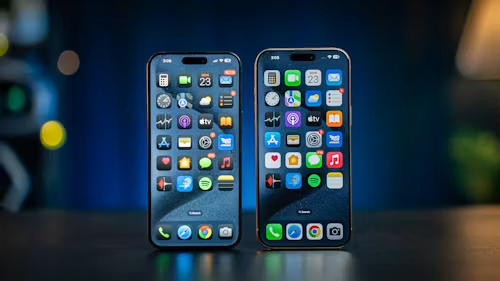
In 2026, the hardware story has largely plateaued. The sensors in the iPhone 17 Pro Max, Samsung Galaxy S26 Ultra, and Google Pixel 10 Pro are excellent — genuinely excellent — but the physical differences between them are marginal. A photography enthusiast with laboratory equipment could measure the sensor quality differences. A human looking at photographs on a phone screen largely cannot.
What separates these cameras now is almost entirely software. Artificial intelligence processing that happens in the milliseconds between pressing the shutter and the image appearing in your camera roll has become the defining competitive battleground in smartphone photography.
The results are extraordinary, occasionally controversial, and genuinely worth understanding, whether you are a casual phone photographer or a serious image maker.
What AI Is Actually Doing to Your Photos
Most people know that AI improves smartphone photos. Very few understand the specific ways it does so — and understanding the mechanisms helps you use your camera more intentionally and evaluate the results more critically.
Computational HDR: Seeing More Than Your Eye Can
Every smartphone flagship in 2026 captures multiple exposures simultaneously when you press the shutter — typically between 9 and 20 frames at different exposure levels — and merges them using AI algorithms that identify the optimal pixel data from each frame.
The result is images with a dynamic range that physically exceeds what any camera sensor can capture in a single exposure. The highlights in a bright sky are preserved while the shadows in a foreground subject are simultaneously opened up — achieving a balance that photographers using dedicated cameras spend years learning to manage through exposure technique and post-processing.
Google’s HDR+ pipeline on the Pixel 10 Pro processes this multi-frame data with semantic scene understanding — meaning the AI identifies what each element in the image is (sky, skin, foliage, architecture, water) and applies different processing parameters to each element. The sky receives one treatment. Skin tones receive another. Shadows receive a third. The image you receive has been processed as a collection of individually optimized elements rather than a single uniform exposure.
This is extraordinary capability. It is also invisible to the user — you press the shutter and receive a finished image without any of the processing being apparent or controllable.
Night Mode: Capturing Darkness That Was Previously Invisible
Night photography before computational cameras required a tripod, a long exposure, and the acceptance that moving subjects would be blurred. Smartphone Night Mode in 2026 has made these requirements largely irrelevant.
The mechanism is multi-frame stacking — capturing between 6 and 30 frames at varying exposures and combining them using motion-compensation algorithms that align static elements while managing moving subjects. The result is a long-exposure equivalent that captures far more light than a single frame while maintaining acceptable sharpness even without a tripod.
Apple’s Night mode on the iPhone 17 Pro Max, Google’s Night Sight on the Pixel 10 Pro, and Samsung’s Nightography system on the Galaxy S26 Ultra all produce images in near-total darkness that would have been technically impossible on any consumer camera platform five years ago. We are not talking about slightly improved dark photos. We are talking about images captured at 0.1 lux — approximately the light level of a room lit only by a distant streetlight — that are sharp, detailed, and usable.
The AI’s role extends beyond frame stacking. Scene classification identifies dark scenes and activates night processing. Noise reduction algorithms trained on millions of low-light images selectively remove noise while preserving fine detail that earlier noise reduction destroyed indiscriminately. Semantic processing applies different noise reduction parameters to different scene elements — more aggressive on smooth surfaces like walls and sky, more conservative on textured surfaces like fabric and foliage.
Portrait Mode: Depth That Was Never There
Portrait mode background blur — bokeh — was traditionally a function of physics. Large camera sensors with wide apertures produce shallow depth of field naturally. Smartphone sensors are too small to produce meaningful background blur optically in most shooting conditions.
Smartphone portrait mode creates this blur computationally — using AI to identify the subject, separate them from the background with pixel-level precision, and apply mathematically generated blur to the background layers.
In 2026, the quality of this computational separation has improved to the point where it is genuinely difficult to distinguish from optical bokeh in many conditions. The iPhone 17 Pro Max’s portrait processing handles the edges of hair — historically the most challenging element for computational separation — with a naturalness that earlier generations could not achieve.
What makes 2026’s portrait AI particularly interesting is that the processing has been extended beyond simple background blur into full lighting simulation. Portrait Lighting modes on iPhone, Galaxy AI Portrait Studio on Samsung, and equivalent features on Pixel can simulate studio lighting setups — placing a virtual key light, fill light, and rim light on a subject photographed in flat, even light. The simulation is not perfect, but it is convincing enough that many casual viewers cannot identify that the lighting was applied in post-processing rather than captured in the original scene.
Scene Understanding and Automatic Optimisation
Every major smartphone camera platform in 2026 performs real-time scene classification before and during capture. The camera identifies whether you are photographing food, a landscape, a portrait, an indoor space, architecture, text, a pet, or dozens of other scene categories — and automatically adjusts processing parameters for each.
Food photographs receive warmer colour rendering and enhanced saturation to increase visual appeal. Landscape photographs receive expanded dynamic range and enhanced sky processing. Portrait photographs activate skin-tone-optimised processing. Text documents receive flattened perspective correction and enhanced contrast.
This automatic optimization is largely invisible and largely beneficial. Most users receive better photographs of their intended subjects without understanding why. The occasional miscategorization — a food photograph processed as a landscape, for example — can produce noticeably wrong results, but these errors are increasingly rare as classification models have been trained on billions of categorized images.
The Generative AI Revolution: When Photos Stop Being Photographs
The most significant and most controversial development in smartphone photography in 2026 is the arrival of generative AI editing tools that fundamentally change what a photograph is.
Magic Eraser and Object Removal
Google introduced Magic Eraser on Pixel devices several years ago. The 2026 implementations across all major platforms have matured into genuinely powerful tools that remove objects — people, signs, power lines, shadows, lens flare — and replace them with AI-generated background content that seamlessly fills the removed area.
The quality in 2026 is remarkable for most use cases. Removing a person from a crowd scene, eliminating a distracting rubbish bin from a travel photograph, or cleaning a background for a product photograph all work reliably when the removed area is against a relatively consistent background.
The philosophical question this raises is significant: if a person has been removed from a photograph using AI-generated replacement content, is the image still a photograph? The pixel data in the removed area was never captured by the camera — it was created by an AI model trained on other images. The answer matters differently for documentary photography and casual social media posts, but the technology does not distinguish between them.
Generative Fill and Scene Extension
Samsung’s Galaxy S26 Ultra and the iPhone 17 Pro Max both offer generative scene extension — expanding the frame of a photograph beyond its original boundaries using AI-generated content that matches the style, lighting, and subject of the original image.
The use case is immediately obvious: a portrait photographed with insufficient background space can be extended to create more visual room. A landscape photograph cropped slightly too tightly can be widened to include more sky. The generated extension is indistinguishable from the original in many conditions.
This capability has significant implications for professional photography workflows. Real estate photographers can extend architectural shots. Product photographers can expand product images to fit different format requirements. Portrait photographers can reframe images after the fact.
AI Sky Replacement and Lighting Adjustment
Sky replacement — substituting an overcast or plain sky with a more dramatic alternative — was historically a time-consuming manual editing task in Photoshop requiring careful masking and compositing. In 2026, it is a single tap on Galaxy AI and a similar gesture on competing platforms.
The AI identifies the sky in the image, creates a precise mask around the horizon and any foreground elements that overlap the sky, replaces the sky with a selected alternative, and adjusts the foreground lighting to match the new sky’s color temperature and intensity.
The results are convincing enough that the feature is genuinely useful for real estate photography, travel photography, and social media content. They are also convincing enough that sky-replaced images are essentially undetectable to casual viewers — raising the same authenticity questions as object removal.
AI Video: The Photography Revolution Extends to Motion
The AI transformation of smartphone cameras in 2026 is not limited to still photography. Video has undergone an equivalent transformation that has received less attention but delivers equally dramatic results.
Video Boost on the Pixel 10 Pro processes captured video through Google’s AI infrastructure after filming, applying HDR+ processing to individual frames, advanced noise reduction, and stabilization enhancement that approaches gimbal-quality output from handheld capture.
Cinematic Mode on iPhone uses AI depth mapping to apply continuously adjustable rack focus to video footage — simulating the focus pulls that professional cinema cameras achieve with dedicated focus pullers. The 2026 implementation on iPhone 17 Pro Max extends this to 4K ProRes at 120fps, creating slow-motion cinematic footage with AI-managed focus that was physically impossible on consumer devices twelve months ago.
Samsung’s AI Video Remaster analyzes existing video — including old footage captured years ago on less capable phones — and applies noise reduction, color correction, and stabilization improvements that bring older recordings closer to current camera quality.
The Authenticity Question: When Is a Photo No Longer a Photo?
The elephant in every room where smartphone AI photography is discussed is authenticity. When AI removes objects that were present, adds lighting that was not there, extends frames beyond what the lens captured, and replaces skies with entirely different atmospheric conditions, the resulting image represents something more complicated than a photograph in the traditional sense.
Professional photography organizations have begun developing guidelines for AI-assisted image disclosure. Several major photo journalism awards now require disclosure of any AI editing beyond color correction and basic exposure adjustment. Stock photography agencies are implementing AI detection and separate licensing categories for AI-assisted images.
For everyday photographers using these tools on social media and personal sharing, the philosophical questions are less pressing but not entirely absent. The photograph of a family dinner where the cluttered background has been cleaned by Magic Eraser records something slightly different from what the camera saw. Whether that matters depends entirely on your purpose.
What is clear in 2026 is that the tools exist, they are built into the default camera experience of every major smartphone, and most users are using them without fully understanding their implications. That is not necessarily wrong — but it is worth knowing.
What Serious Photographers Think
The photography community’s response to AI camera processing in 2026 is genuinely divided, and both sides make valid points.
Photographers who embrace AI tools point to democratization — the ability for anyone to capture technically excellent images regardless of skill level has expanded visual storytelling to people who previously lacked the technical knowledge to operate camera equipment effectively. A parent capturing a child’s birthday party in poor lighting receives images that would have required professional equipment and expertise a decade ago.
Photographers who are skeptical argue that the optimization is homogenizing. When every phone from every manufacturer applies similar AI processing to maximize visual impact, the resulting images start to look similar regardless of where they were taken or who took them. The individual creative vision that distinguishes one photographer’s work from another’s is being smoothed out by algorithms optimizing for universal appeal metrics learned from millions of liked images on social media platforms.
Both perspectives are right. AI has made technically excellent photography universally accessible. It has also made stylistically distinctive photography slightly harder to achieve on default settings, because the defaults are aggressively optimized rather than neutral.
The serious photographers we spoke with for this article have largely arrived at the same practical conclusion: shoot in RAW format where available, disable the most aggressive AI optimizations for work where authenticity matters, and embrace AI assistance selectively for specific use cases where the tools genuinely serve the image rather than replacing the photographer’s vision.
What Comes Next: AI Photography in Late 2026 and Beyond
The trajectory of AI smartphone photography points toward several developments that will become mainstream within the next 12 to 18 months.
Real-time AI composition assistance — live viewfinder overlays suggesting framing improvements, subject repositioning, and lighting adjustments before capture — is already available in limited form on several Android devices and will become a standard feature across the industry.
Personalized AI processing trained on individual preferences rather than population-wide aesthetics will allow users to establish a consistent personal visual style that the AI applies across all captures — creating something closer to a genuine signature look rather than a manufacturer-defined processing profile.
Video to cinematic transformation using generative AI to apply professional color grading, cinematic aspect ratios, and motion picture aesthetics to everyday video footage automatically is arriving in beta form on multiple platforms.
Cross-device AI photography that begins editing on a phone and continues seamlessly on a tablet or computer using a unified AI understanding of the image and the photographer’s preferences will make the smartphone-to-final-image workflow genuinely fluid.
The Bottom Line
AI has not made smartphone photography better in the way that a better lens makes photography better. It has changed what smartphone photography fundamentally is — moving it from a process of capturing light to a process of generating the best possible image of a scene using every computational resource available.
The results, for most users in most situations, are genuinely stunning. The images produced by the best AI-powered smartphone cameras in 2026 are more technically accomplished, more visually impactful, and more consistently good than anything a consumer device has produced before.
The implications — for authenticity, for the definition of photography, for the development of individual visual creativity — are genuinely worth thinking about as these tools become more capable and more invisible simultaneously.
The camera in your pocket in 2026 is the most powerful imaging tool most people have ever carried. Understanding what it is doing with your images makes you a more intentional photographer, regardless of whether you embrace or question the AI transformation shaping every shot you take.
Want weekly deep-dives on AI, smartphone cameras, and the technology reshaping how we see the world? Subscribe to the TechMuse newsletter — completely free, no spam, unsubscribe anytime.
Sources and Disclaimer
Technical information on computational photography and AI processing pipelines sourced from official developer documentation and research publications from Google AI Blog, Apple Machine Learning Research, and Samsung Research, current as of July 2026. Camera performance references based on TechMuse editorial testing of retail units of the iPhone 17 Pro Max, Samsung Galaxy S26 Ultra, and Google Pixel 10 Pro. AI photography ethics and professional photography community perspectives informed by guidelines published by the National Press Photographers Association, World Press Photo Foundation AI disclosure standards 2026, and Getty Images AI content policy documentation.