
Every year brings a fresh wave of “trends to watch” lists padded with buzzwords that go nowhere. Here’s a more honest cut: the technology shifts in 2026 that are genuinely changing what you buy, how you search, and what shows up in your everyday apps.
1. AI Moves From Chatbots to Agents
The biggest shift in AI this year isn’t a smarter chatbot — it’s AI systems that can actually take multi-step action on your behalf: booking things, managing accounts, and completing purchases within limits you set. See our full explainer on AI agents for the details, but the short version is that “AI that talks” is giving way to “AI that does”.
2. AI Consolidation at the Infrastructure Level
Nvidia’s $12.9 billion acquisition of Hugging Face in September 2026 is the clearest signal yet that the companies controlling AI hardware want to also control the platforms where AI development actually happens. Expect more consolidation like this through 2026 and 2027, as major tech companies compete to own more of the AI stack — not just chips, not just models, but the entire pipeline in between.
3. Search Is Becoming Answer-First
Google, Bing, and AI tools like ChatGPT and Perplexity increasingly show a direct answer before you ever click a link. This is reshaping how websites write content — shorter, clearer, answer-first sections are winning over long padded articles, and it’s also changing how you should evaluate information you’re given instantly rather than sourced from a page you can inspect yourself.
4. 5G Expansion Continues, 6G Research Ramps Up
5G rollout is still expanding into more regions and price tiers rather than slowing down, making genuinely affordable 5G phones more common. Meanwhile, early 6G research is underway among telecom equipment makers and standards bodies, though consumer 6G devices remain years away — treat any “6G phone” marketing claims in 2026 with real scepticism.
5. Robotics Moving Beyond Factories
Robotics investment has expanded well beyond industrial and warehouse use cases into more general-purpose applications — a trend visible in the surge of robotics startups gaining attention this year. Home and service robotics remain early-stage for consumers, but the underlying technology is maturing faster than in previous years.
6. AR/VR and Spatial Computing, Slowly
Augmented and virtual reality continue incremental progress rather than a breakout moment — better hardware, lighter headsets, and more practical use cases in specific industries (design, training, and remote collaboration) but still short of mainstream consumer adoption. If you’re waiting for AR glasses to replace your phone, that’s still a few years out.
7. Cybersecurity Gets More Urgent, Not Less
As AI models become easier to access and deploy (accelerated by moves like Nvidia-Hugging Face expanding open model access), the tools available to both defenders and attackers are advancing together. Expect security to be baked more directly into AI infrastructure itself in 2026, rather than bolted on afterward.
8. Edge Computing Quietly Grows
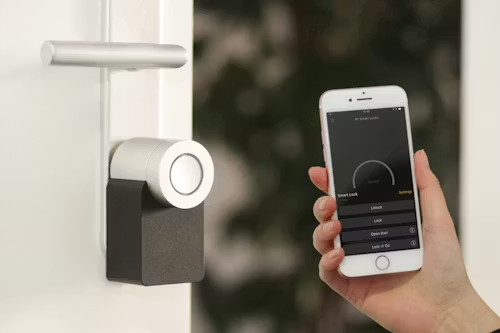
More processing is happening directly on your device rather than in the cloud — partly for speed, partly for privacy, and partly because on-device AI features (in phones, laptops, and smart home devices) no longer require a constant internet connection to work well.
What This Means for You as a Buyer
Practically speaking, if you’re shopping for a phone or laptop in 2026, look for genuine on-device AI features (not just cloud-dependent “AI” marketing), don’t overpay for 6G claims that are years premature, and expect AI-agent-style automation to increasingly appear as a real feature rather than a gimmick in mainstream apps you already use.
Bottom Line
The pattern across all of this: AI is moving from a feature you talk to into infrastructure that acts, search is compressing into instant answers, and the physical technology around it (chips, networks, robotics) is consolidating and maturing to keep pace. None of this is science fiction — it’s already showing up in the products on shelves right now.
This overview reflects industry reporting and analysis as of September 2026 and will continue to evolve as these trends develop.