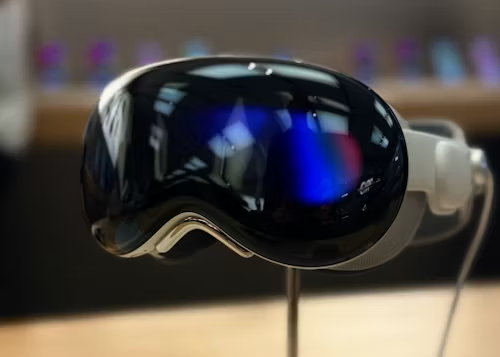
Apple Vision Pro Buying Guide: Is It Worth the Splurge in 2026?
Apple’s Vision Pro is one of the most technically impressive products the company has ever shipped — and also one of the hardest to justify buying for most people. Here’s an honest breakdown of what it actually is, what it costs, and who should genuinely consider one in 2026.
What the Vision Pro Actually Is
Apple doesn’t call the Vision Pro a VR headset — it markets it as a “spatial computing” device, and that distinction matters. Rather than being built primarily for gaming or immersive VR content the way a Meta Quest is, the Vision Pro is designed around windowed apps, productivity, and mixed reality that blends digital content with your real surroundings. It runs on Apple’s M5 chip as of the current model (refreshed from the original M2 version in October 2025), paired with a dedicated R1 chip for real-time sensor processing, and features dual micro-OLED displays delivering a combined 23 million pixels — genuinely the sharpest display in any consumer headset available today.
Current Vision Pro Pricing
As of mid-2026, Vision Pro pricing sits at:
- 256GB: $3,499
- 512GB: $3,699
- 1TB: $3,899
Worth noting: Apple raised prices in June 2026, a change tied to the broader memory chip shortage affecting the entire electronics industry, not something specific to the Vision Pro itself. Once you factor in accessories and AppleCare+, the real-world total cost for a well-equipped setup commonly approaches $4,000-5,000.
Who the Vision Pro Is Actually Built For
Reviewers and industry analysts are unusually aligned on this point: the Vision Pro remains a niche, professional-tier device, not a mainstream consumer purchase. It makes the most sense for:
- Developers building VisionOS apps who need the hardware to actually test and ship on the platform
- Enterprise and professional workflows — architectural walkthroughs, 3D and volumetric video editing, industrial design prototyping, and specialised research applications
- High-budget early adopters who specifically want the best available display and don’t mind paying a significant premium for it
Where the Vision Pro Falls Short for Everyday Buyers
- The app ecosystem remains limited. There’s still no single “killer app” that justifies the price for typical productivity or entertainment use, several years after launch.
- Comfort and battery life are real limitations. Extended wear remains a common complaint, and the external battery pack limits untethered use.
- The gaming library is thin. Competing headsets like the Meta Quest 3 offer over 1,000 titles; Vision Pro’s library is a fraction of that size, and Apple’s own positioning leans away from gaming as a primary use case anyway.
- Apple doesn’t discount it. Unlike nearly every other Apple product, the Vision Pro has held firm at its list price with no meaningful sales, so there’s no “wait for a deal” strategy here.
Should You Buy an Apple Vision Pro Now, or Wait?
There have been persistent rumours of a lower-cost “consumer tier” Vision headset, projected in the $1,499-1,999 range, though nothing has shipped as of this writing, and reporting suggests development on a true next-generation headset has actually paused for now. If your interest is purely casual — wanting to try spatial computing without a defined professional use case — waiting to see whether a genuinely more affordable model materialises is the more sensible move. If you have a specific, quantifiable professional workflow that the Vision Pro’s display and tracking precision would meaningfully improve, the current M5 model is a reasonable buy today, since Apple has said another hardware update isn’t expected for at least two more years.
Vision Pro vs. Cheaper Alternatives
If gaming or general entertainment is your primary interest rather than professional spatial computing work, it’s worth being aware that headsets like the Meta Quest 3 offer a far larger content library at a small fraction of the Vision Pro’s price. The Vision Pro’s advantages — display sharpness, build quality, and tight integration with the Apple ecosystem — matter most if you’re already bought into that ecosystem and have a specific use case those advantages actually serve.
Bottom Line
For the overwhelming majority of people reading a “Should I buy this?” guide, the answer is no — not because the hardware isn’t impressive, but because the price and app ecosystem don’t yet justify it outside of specific professional or developer use cases. If that’s not clearly you, this isn’t the Apple product to spend your money on in 2026. Looking for where Apple’s money is better spent for most people? See our AirPods buying guide for a genuinely mainstream Apple wearable purchase.