Smart Rings Explained: What They Track, and Whether They’re Worth It
Smart rings have quietly gone from a niche gadget to one of the fastest-growing categories in wearable tech. If you’ve been wondering what they actually do and whether one is worth adding to your routine alongside (or instead of) a smartwatch, here’s the honest breakdown.
What a Smart Ring Actually Is
A smart ring is a small, screen-free ring packed with sensors that track health metrics continuously throughout the day and night. Using optical sensors and motion detectors, most smart rings monitor heart rate, heart rate variability, skin temperature, sleep stages, and daily activity, syncing that data to a companion app on your phone. Unlike a smartwatch, there’s no display, no notifications, and no buttons — the entire point is that it fades into the background of your day while still collecting continuous data.
What Smart Rings Track
The core feature set has become fairly consistent across the category:
- Sleep tracking and staging — how long you spend in each sleep stage, not just total hours slept
- Heart rate and heart rate variability — continuous background monitoring, rather than the spot checks a smartwatch often relies on
- Recovery and readiness scores — a daily summary translating your overnight data into a sense of how recovered your body is
- Activity and step tracking — general movement throughout the day, including some rings that credit non-exercise activity like housework
- Skin temperature — useful for spotting patterns tied to illness or cycle tracking
Some newer models are expanding into blood oxygen monitoring and early blood pressure trend tracking, though it’s worth being clear-eyed about this: these features are generally positioned as wellness trend indicators rather than clinical-grade medical measurements, and coverage of the category has noted that accuracy for advanced metrics like blood pressure and blood oxygen can vary between models, with occasional inconsistent readings reported during testing. If you’re looking for a device to manage a diagnosed health condition, talk to a doctor about what’s actually validated for that purpose rather than relying on a consumer wearable.
The Two Names You’ll See Most
Oura Ring is widely considered the most comprehensive smart ring on the market, with detailed sleep staging, recovery scoring, and an expanding set of health features. The trade-off is a required monthly subscription (currently around $5.99/month) to unlock full insights and historical data—the ring itself doesn’t do much without it.
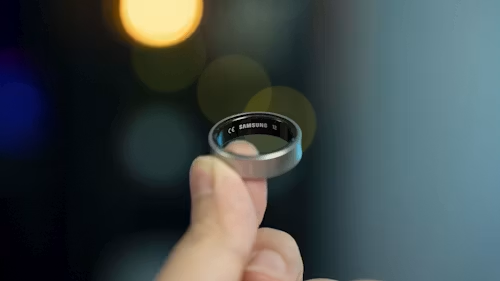
Samsung Galaxy Ring is Samsung’s entry into the category, and its biggest advantage is tight integration with Samsung Health and the broader Galaxy ecosystem — if you already own a Samsung phone or watch, the ring’s data folds directly into an interface you’re already using, with no subscription required. The trade-off is that it’s Android/Samsung-focused, with no meaningful iOS support.
Subscription-Free Alternatives
If a monthly fee is a dealbreaker, you’re not limited to Oura or Galaxy Ring. Options like the RingConn Gen 2, Ultrahuman Ring Air, and Amazfit Helio Ring all offer capable health tracking without an ongoing subscription, generally trading some of the polish and depth of insight for a lower total cost of ownership.
What Smart Rings Are Genuinely Good At
- All-day, all-night comfort. Most people find a ring far less intrusive to wear 24/7 than a watch, especially while sleeping.
- Battery life. Typical smart rings run around 4-7 days per charge, well beyond what most smartwatches manage.
- Discretion. No screen, no notifications, no obvious “smart device” appearance — it just looks like a ring.
Where Smart Rings Fall Short
- No screen means no at-a-glance information. You can’t check the time, see a notification, or glance at your stats without pulling out your phone — a real trade-off compared to a smartwatch.
- Limited workout tracking. Smart rings generally aren’t built for tracking specific exercise types the way a fitness-focused smartwatch is and tend to be better suited to passive, background health monitoring than active workout logging.
- Sizing can be a real hassle. Unlike a watch with an adjustable band, a ring needs to be the correct size, and most brands require ordering a sizing kit before you can buy the actual product.
Is a Smart Ring Worth It?
Worth it if you want continuous, unobtrusive sleep and recovery tracking; you find a smartwatch uncomfortable to wear at night; or you specifically want data on trends over time rather than real-time stats throughout the day.
Skip it if you rely on your wrist device for workout tracking, notifications, or at-a-glance information throughout the day — a smartwatch will serve you better for all of that. It’s also worth knowing that many current smartwatches, including the Apple Watch Series 11, now offer similar background health tracking (sleep scoring, heart health monitoring) without needing to add a second wearable device at all.
Bottom Line
Smart rings aren’t a smartwatch replacement for everyone, but for a specific kind of user — someone who wants deep, passive sleep and recovery data without wearing a screen on their wrist — they’ve become a genuinely mature and useful category in 2026. Decide based on which ecosystem you’re in (Samsung vs. subscription-agnostic options) and whether you’re willing to pay an ongoing fee for the deepest insights, rather than assuming any one ring is the automatic best choice.