iPhone Air Review: Apple’s Revolutionary Thinnest iPhone Ever
The iPhone Air is the boldest thing Apple has done to the iPhone lineup in years. It isn’t a bigger or smaller version of an existing model — it’s a phone built around a single, uncompromising design goal: thinness. At 5.6mm, it’s the thinnest iPhone Apple has ever shipped. Here’s what that trade-off actually costs you, and who it’s genuinely worth it for.
Design: The Whole Point of This Phone
Holding the Air is a different experience from any other current iPhone. It’s noticeably thinner and lighter than the standard iPhone 17, despite carrying a larger 6.5-inch display. If the physical feel of your phone matters to you — how it sits in a pocket, how it feels in hand over a long day — this is where the Air makes its strongest case, and no spec sheet comparison fully captures it. This is a phone you need to actually hold to understand the appeal.
Display
The 6.5-inch OLED display is genuinely excellent and slightly larger than the standard iPhone 17’s screen despite the Air’s much slimmer body. It shares the same 120 Hz ProMotion refresh rate, Always-On Display, and 3,000-nit peak outdoor brightness as the Pro models, so you’re not sacrificing display quality to get the thinner design — this is a case where Apple didn’t cut corners.
The Real Trade-Offs
This is where buying decisions should actually be made, and where the Air asks the most of you.
Camera
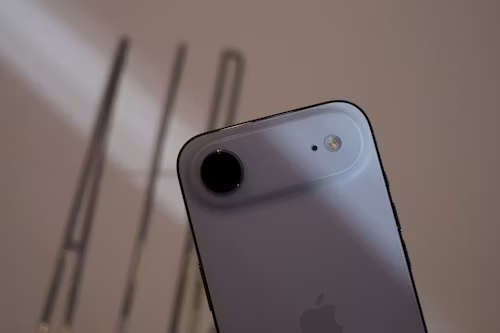
The Air ships with a single 48MP rear camera, rather than the dual setup on the standard iPhone 17 or the triple setup on the Pro models. You lose the ultrawide and telephoto lenses entirely. For casual photography — everyday shots, social media, general use — the single lens performs well. But if you regularly use ultrawide shots for landscapes or group photos, or telephoto zoom for distant subjects, that functionality simply isn’t available here, and no software processing fully replaces a dedicated second or third lens.
Battery
Fitting a battery into a 5.6 mm body meant real compromises on capacity. Real-world battery life on the Air is noticeably behind the standard iPhone 17 and well behind the Pro models — manageable for lighter days, but heavy users (streaming video, gaming, heavy camera use) will likely need a midday top-up more often than they would with other models in the lineup.
Performance
Despite the thin design, the Air doesn’t skimp on power — it uses the same A19 Pro chip found in the Pro models, meaning day-to-day performance, app responsiveness, and on-device AI processing are genuinely on par with the more expensive Pro tier. This is a real point in the Air’s favour: you’re not paying a performance penalty for the thinner design.
The C1X Modem
The Air uses Apple’s own C1X 5G modem, part of Apple’s ongoing shift away from third-party modem chips. In practical terms, this shouldn’t be something you notice day-to-day if it works as intended, though it’s worth knowing this is newer, in-house modem technology rather than a long-established third-party component — historically, first-generation in-house components carry slightly more uncertainty than mature, well-tested alternatives.
Who Should Buy the iPhone Air
- You care more about how your phone feels than about having multiple camera lenses. If thinness and weight are genuinely important to your daily experience, this phone delivers something no other current iPhone can.
- You’re not a heavy photographer. Casual, everyday photo use won’t miss the ultrawide or telephoto lens much. Frequent zoom or wide-shot users will.
- You can live with charging more often. If topping up midday isn’t a hassle for your routine, the battery trade-off is manageable.
Who Should Skip It
- Anyone who leans on multi-lens photography — group shots, landscapes, or zoomed shots are a real limitation here, not a minor one.
- Heavy daily users who need all-day battery without a midday charge — the standard iPhone 17 or either Pro model will serve you better.
- Buyers who want the absolute best value — at $999, the Air costs $200 more than the standard iPhone 17 while offering a less capable camera system; the price here is for the design, not for added capability.
Bottom Line
The iPhone Air isn’t trying to be the best iPhone for everyone, and it shouldn’t be judged as though it is. It’s a genuinely well-executed statement phone built around a design goal Apple clearly prioritised above camera versatility and battery capacity. If that trade-off appeals to you specifically, this is a remarkable piece of engineering. If it doesn’t, the standard iPhone 17 or a Pro model will serve your actual needs better for similar or less money.