Quick answer: For about 90% of buyers with a standard flat-screen phone, tempered glass wins — better impact protection, clarity closer to the bare screen, and touch response that feels natural. Film only makes sense for curved Samsung Galaxy screens, foldable phones, or a genuinely tight budget.
The Core Difference
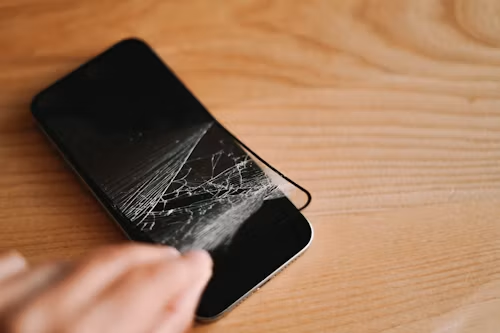
Tempered glass is a rigid, heat-treated glass layer, typically 0.3-0.5 mm thick, that sits on top of your screen and can crack or shatter to absorb an impact that would otherwise damage the actual display. Film — usually PET or TPU plastic — is thinner, flexible, and focuses more on scratch resistance than serious impact absorption.
When Tempered Glass Is the Right Call
- You have any flat-screen iPhone or standard Android phone. This covers the vast majority of devices sold today.
- You’re worried about drops, not just scratches. Glass spreads and absorbs impact force in a way film simply can’t match.
- You want the display to look and feel like the original screen. Glass offers superior clarity and touch sensitivity compared to film, assuming a clean, bubble-free installation.
When Film Makes More Sense
- You have a curved-edge screen (some Samsung Galaxy models) or a foldable phone. Glass doesn’t conform well to curves or folds and can lift at the edges or crack along a fold line. Film stays properly adhered.
- You’re on a strict budget. Film is generally cheaper, though a quality multi-pack of tempered glass (like amFilm or JETech) often beats single-piece film on price-per-unit anyway.
- You want a specialised effect — privacy filtering, matte anti-glare — that’s more commonly available in film form.
A Middle Option: Ceramic Film
Ceramic film is a newer hybrid — thinner and more flexible than glass, but tougher than standard plastic film, and better suited to curved or foldable screens than rigid glass. It resists cracking under small, frequent bumps (like a pocket slip), though it doesn’t match tempered glass for a single hard, high-energy drop. If you own a foldable or curved-screen phone and want better protection than basic film without the fitting problems of glass, ceramic film is worth the modest price premium.
Quick Comparison
| Tempered Glass | Standard Film | Ceramic Film | |
|---|---|---|---|
| Best for | Flat screens | Budget, curved edges | Foldables, curved screens |
| Impact protection | Best for hard drops | Weakest | Good for small daily bumps |
| Clarity | Excellent | Can be grainy | Good |
| Fits curves/folds | Poorly | Well, | Very well |
| Typical cost | Low-moderate | Lowest | Moderate |
Installation Tip
Tempered glass is generally easier to install bubble-free than film, since its rigidity helps it self-align during placement. If you’ve struggled with bubbly, misaligned film in the past, glass is likely to give you a cleaner result even as a first-timer.
Bottom Line
If your phone has a standard flat screen — which covers most iPhones and a large share of Android phones — buy tempered glass and don’t overthink it further. Only reach for film or ceramic film if you specifically own a curved or foldable screen, or your budget genuinely can’t stretch to a quality glass multi-pack.
For full-device protection, pair this with a good drop-tested phone case.